Tuesday, June 14, 2005

Tarima kasi Tibang village Banda Aceh June 2005


Tibang village is in Shekwala region near the coast in Bande Ache. All the houses were destroyed. explained ….. ‘Our work is based on community approach, we help the community build their houses, using home partners together with volunteers of habitat.’ over a 2 year period – Habitat for Humanity are doing a 2 yr programme for 376 families, building some 300 homes –
Some were more temporary ‘kacca’ houses next to newer more permanent ‘pakka’ houses I was able to talk to a number of people and tape their interviews :

Mr Emjamil (Baba Jamil) aged 52 . There were 12 in the extended family now 7, inc grandchildren . They ran on foot, but 5 died. His daughters Annan Nuraini lost 1 child whilst Erline has a miscarriage Now they help on a ‘cash for work’ cleanup programme. Previously they were housewives whilst Emjamil was a shrimp fisherman. They all want to stay in the village. ‘We will run again when the next earthquake comes’ On that fateful day 3 waves came 1st c 4m, second 10+ m, the third was smaller. Village of Alunnaga was between their village and the sea Now it has disappeared and all they can see is the palm trees on what is now a much nearer sea shore.

Fatima, an elderly woman with a machete, cutting a coconut. Since the Tsunami, she is now staying with her sister Jainalabbidin A single aunt also living with them. The 2 sisters will have a H4H house built. Escaped Tsunami with sisters in a car. They are very thankful that God has given them a house.

Jehora - We met another old woman. She came out of her house and insisted that her photo be taken as well. I was curious that people want their story heard. It was an event so tumultuous that she felt it needs to be recorded. There were 12 people in Jehora’s family. ‘I was in the house and when the waves came. I ran with my husband on the motorbike’ There were 4 on the bike who were saved. 5 were killed - a granddaughter, 2 grandsons, son and son-in-law. Her husband, Suleiman with the straw hat worked as collector of rubbish in the market. Now he too is on a ‘cash for work’ programme - Cleaning up the site.

The mosque had been destroyed. The marble floor remains and a pulpit - ‘Allah’ engraved into the wood one side and ‘Mohammad’ the other - A water damaged copy of the Q’ran lay open, a silent testament in the midst of the destruction. The plaque word ‘Masjid’ itself had been split in two as had this fishing village

I asked the Habitat worker, Iskandar, to read something from the open page. He recited from the Qu’ran from Surah quote - Surah Alamania / Yahulmania pg 35 - ‘Everything is coming from God and is God’s will and everything is coming from God.’ (check translation)

All I was able to say were the only 2 words I had learned - ‘Terima Kasi’ - Thankyou.

Monday, May 16, 2005

Straws in the wind Afghanistan May 2005


According to Pakistan’s National Poet – Mohammad Iqbal (1876-1938)
Asia is a living body, and Afghanistan is its heart.
In the ruin of the heart lies the ruin of the body;
So long as the heart is free, the body remains free;
If not it becomes a straw adrift in the wind.
The War years
Afghanistan has been devastated by over a quarter of a century of fighting. Asia has suffered a massive heart attack! The wars left a country in ruins, with hundreds of thousands of casualties and millions of refugees. The infrastructure destroyed, along with many of the natural agricultural resources. It remains the second most mined country in the world.
A cartoon in the Frontier Post in 1992 suggested that KABUL stood for Killing Assassination Bloodshed Uncertainty Looting. I have travelled to Kabul a couple of dozen times now. I have been struck by both the wanton destruction, with half of the buildings destroyed, as well as the resilience of the people who made shops out of containers and cups out of coke cans. Life has a way of going on.

Today there are many signs of hope, lots of traffic on the roads. Men, bearded and unbearded, and women, veiled and unveiled, walking the streets again. Shops and businesses re-opening. And of course all the rebuilding - with a new energy and vigour.
So what might KABUL stand for today ? maybe Kerzai - the interim prime minister representing the constitution and future government. Administrative centre - the commercial and civil capital of the country. Buildings being restored – a symbol of hope. United Nations agencies and other international NGOs working with the government. Logistics – the enormous amount of resources needed to rebuild the country.

In this complex context our partner agency, has been working throughout the war years, almost non-stop since 1966, dedicated to serving the people of Afghanistan. It has won the respect of local people, who have witnessed the dedication of the workers and their commitment to the country and its peoples.

Oriental Wisdom

I love the tales of Mullana Nusradin. These tales from Central Asia, Middle East and North Africa, attributed to Sufis and dervishes, illustrate aspects of human nature and religious insight. The Mullana can be naïve and nonsensical, sensible and sanguine, a blundering fool and a wise sage. A wonderful blend of folly and wisdom.

I like the story of the lost key. Mullanan Nusradin is seen on his knees looking for something in the light of a doorway. ‘What are you doing?’ he is asked. ‘I am looking for a lost key!’ ‘Where did you lose it?’ ‘In the basement, but it is too dark to see anything there so I am looking where its light!’ In a sense that describes the state of many who have lost the key or lost their way and are looking in the wrong place, searching where it is more convenient.

For me the key is committed service, a practical expression of love.

Our partner agency in Afghanistan is made up of over 25 member agencies, who supply people and resources to run the various projects. There are a currently around 160 expatriate workers, with around 60 children, plus over 500 local Afghan workers. 10% of the expats are from CMS, working in every sector of the organisation – the central administration, as well as the projects. They serve in a variety of roles and responsibilities which reflect the huge variety of the organisation as a whole:
a Primary Mental Health project, teaching English to nationals, a pharmacist working for the National Eye Care programme, managing a school for the visually impaired, logistical support, communications, teaching children of expatriate team members, mother and child health, community development, and disaster management.
Maybe just one project can illustrate the potential impact of this work.

Superflour
The country's war-torn recent history has left many widows, as well as men unable to work because of ill-health. Chronic malnutrition affects over 50% of children under five, according to the world food programme. The disaster management project has introduced the concept of 'Superflour' to local people. The words 'simple' and 'genius' might have been invented to describe this idea, first developed by Miriam Krantz, a Mennonite worker in Nepal.
 
The recipe is simple: two parts grain, one part pulses. A nutritious flour results, which can be produced by local women using local ingredients: here they use corn, rice and chickpeas. With water and a teaspoon of oil, it makes a 'super-porridge’, which both tastes good and helps children to recover from malnutrition. Add a little wheat flour and you can make bread and cakes too.

The project is entirely run by women: a local project officer and two supervisors work with 34 others to produce the flour - they are all the main breadwinners for their families. "The women clearly enjoy working together and they have enjoyed the other training in literacy, health education and numeracy that we have given them," says one CMS worker.
 
So does Superflour really have super powers? It sometimes seems like it: "It changes the lives of those who prepare it as they gain confidence and self-esteem," says the CMS worker, "their neighbours ask them about health issues and their husbands (if they have them) include them more in decisions that affect the family."
 
It is hoped that the project will grow into a women's co-operative and spread throughout the country. Meanwhile, the project officer now gets introduced to young children on the street by their mothers with the words: "This woman helped you get strong!"

Yoghurt in the Lake
One day Mullana Nusraddin was sitting by the side of the lake, putting Yoghurt into the water. The people came and asked him ‘what are you doing?’ ‘I’m putting starter in the Lake to make Yoghurt’ he replied. ‘But you can’t turn this whole lake into Yoghurt!’ they protested. Nusraddin smiled and replied ‘I know its impossible, but what if I succeed!?’


All these activities may seem straws in the wind or yoghurt in the lake. But simple ideas or actions can so easily spread and have a huge impact.

Tuesday, November 09, 2004

In the Beginning Karachi November 2004


Younger versions of Joel and I, outside Holy Trinity cathedral, back in 1994


I was given a gold ring when I left Karachi by my 'brothers' and colleagues. Inside it is simply engraved ‘1986-1996 IBTIDA’ It represented 10 years of ministry in drug rehabilitation. I wear it as a reminder of what was, as well as motivation to pray for what will be.  This last visit was just a lightning visit, en route to Afghanistan, but still a journey to my Pakistan roots. Back to the beginning, where my own personal Pakistan journey started, as well as CMS’s journey in addiction ministry.

IBTIDA (Urdu for Beginning) is a church-based NGO, which had been operating since 1985, providing a community-based drug rehabilitation programme to Heroin addicts in Karachi.. Over the years, a lot of resources have been gathered and a resource centre is operating, producing a magazine, books and other drug related materials. Drug and AIDS prevention programmes and Seminars are also run in Bustees (slums) and Churches. Ibtida has been involved in Networking with other non-government organisations and has helped set up a network within Pakistan called DAWN (Drug and Aids Workers’ Network).

CMS has contributed a lot to IBTIDA over the years - 3 sets of mission partners: David and Alison , ourselves – (the Simpsons), Paul and Helen, who then handed over to Pakistani leadership in Valentine Philip (before his untimely and sudden death.) Joel and Jamil came to UK as Interchange visitors. Rev Julian  and others have attended the ISAACS drug training in Egypt. And an exchange visit to India for fieldworkers is being organised.

In my day ‘Ibtida’ was an open, community-based programme. We chased all around the city, visiting addicts where they were using (known in the trade as ‘Outreach work’). They usually came off heroin in their own homes with lots of support from recovering addicts (both prayer and practical) and a family support programme And then entered a ‘90 day Recovery Group’ of regular self-help meetings. It was a ‘Fellowship of recovering addicts’ (similar to NA)

Now it is residential programme of some 30 beds, crammed full of recovering addicts, desperate for a new beginning. They still work with drug users at all stages of the Rehabilitative Process, establishing contact though the field work and generating interest (motivational counselling) and a follow up programme. Only the rehab phase is residential.


As a pastoral work of the Church of Pakistan, it operates under the authority of the Bishop of Karachi. But is now run by Monica, the first woman co-ordinator. She too will be going on the Isaacs’ course in Egypt in 2005. She is already making her mark, established new systems to strengthen the work. There was recently a Mela (fair) which raised over 1 lakh rupees (c £1000). All local support. 

The project is full with 32 addicts going through residential treatment. And an ‘Alumni’ has been set up of older recovering addicts (RAs) lead by Joel who is standing with me in the picture. They act as role models for newer RAs. It was pure delight to see some of the same old faces and many new ones . A healthy sign of growth. God’s work continues…

From your own correspondent

Karachi November 2004  (and 1986-1996)

Friday, October 29, 2004

The Lost Message of Jesus London Oct 2004


The Lost Message of Jesus


Steve Chalke

I attended what was jokingly referred to as ‘Chalke-gate’. Put on by the Evangelical Alliance at Emmanuel Evangelical Church in Marsham Street (London SW1), it was a “public debate on the issues raised by Steve Chalke’s controversial book, ‘The lost message of Jesus’ ”

Joel Edwards; chairs the Evangelical Alliance (EA) and like me is an ex-Probation Officer. He set some helpful ground rules for the evening, as he called for ‘robust love; truth and grace’. The format was simple enough (if somewhat lengthy). Opening statements from each side, Steve Chalke vs. Simon Gatherall with responses and then further statements from 2 other guest speakers: Stuart Murray Williams vs. Anna Robbins. A break and then questions from Joe Public, closing statements, conclusion and prayer. It was chaired by Derek Tidball of LBC Steve Chalke is the founder of the charity Oasis and a popular broadcaster. He is able to communicate with passion and conviction. His theology is forged in everyday encounters with people on the margins. He is a practitioner who gets his hands dirty and has to find answers to the man in the street who questions the very roots and foundations of our faith.

His emphasis on ‘original goodness’ rather than ‘original sin’, on orthodoxy and ortho-praxis together - His is an 'applied theology', not just an academic one, although he is well read.
The bone of contention is what has been academically termed ‘penal substitution’, which has become the dominant evangelical understanding for the cross. Chalke has termed it a form of ‘’cosmic child abuse’, which he claims is a popular accusation found in any pub discussion on Christianity. This is what has riled so many, causing accusations of heresy and withdrawal of support for his projects.

Karl Barth once accused British Christianity, with its emphasis on God’s creation, man’s freedom of choice and a practical faith, of being "incurably Pelagian”. I wondered if PELAGIUS 355-435  had had similar treatment as he was accused of heresy, by Augustine and others. 
Stuart Murray Williams, author of ‘Post-Christendom’, and a Mennonite, summarised part of his book. Christians were initially a powerless deviant minority, a counter-cultural community, which concentrated on the incarnation and living out the message of Jesus. Post-Constantine the Church became the centre of power, ‘Christendom’. It became violent, coercive, more doctrinal (cf. ecumenical creeds), and the emphasis became ‘the birth to death of Christ with nothing in between’. Christ's life had become disturbing, pushed to the margins by the empire. The radical message of Jesus was lost 400 AD and needs to be recovered. Amen to that!
(Stuart Murray William’s statement)

I was left with a question. Does an emphasis on ‘penal substitution’ lead to an evangelical jugmentalism? This has been evident in a lot of what has been written in the Christian press, as well as some of the comments in the hall. A form of graceless Christianity.

Steve was awarded an MBE for ‘services to social inclusion’ His theology also seems more socially inclusive than most.

I noticed two scripture texts above the stage:
John 10:10 ‘I have come that they may have life’
Matt 1: 23 ‘Emmanuel, God with us’.

Maybe God was trying to tell us something.

Tuesday, October 26, 2004

Balthasar’s Odyssey October 2004


Amin Maalouf: ‘Balthasar’s Odyssey’ (Vintage 2003) translated from the French by Barbara Bray
ISBN 0 09 945208 1

see review on  http://www.spikemagazine.com/0704aminmaalouf.php


Ottoman Istanbul   

Anticipating a global catastrophe in 1666 the ‘year of the beast’, when the end of the world is prophesied, Balthasar Embriaco, a dealer in curiosities from the Levant, sets out in search of a rare book. In addition to the 99 names revealed in the Koran, the ‘Hundredth Name’ is thought to reveal the highest name of God, which will be able to avert the apocalyptic disaster. Balthasar’s Odyssey takes him to Constantinople through treacherous Mediterranean seas to Genoa and through a naval war zone to Europe. He arrives in London shortly before the Great Fire.

The insights from people on the journey seemed somehow relevant to today’s inter-faith arena.

The Blind Sheikh Abdel-Bassit:
‘Istanbul, Istanbul. To those that have eyes it’s hard to say the world has nothing to show. Yet it’s true, believe me. If you want to know the world, all you need to do is listen. What people see when they travel is never more than an illusion. Shadows chasing other shadows. The roads and the countries teach us nothing we don’t know already, nothing we can’t hear within ourselves in the peace of the night'  (p24)
Boumeh, his nephew:
‘Allah is just a concentration of ‘al ilah’ which simply means ‘the god’ It’s not a name, it’s just a designation’. (p 96)
Ali Esphanai, fellow traveller:
Ever since the dawn of Islam scholars have argued over a verse that occurs three times in similar terms in the Koran and lends itself to various interpretations. He quoted the phrase carefully: ‘Fa sabbih bismi rabbika-I-azim,’ which may be translated as ‘Glorify the name of your Lord – the Most High. The ambiguity arises from the fact that in Arabic the epithet ‘I-azim’, ‘the Most High’, may refer wither to the Lord or to His Name. In the first case the verse is merely a normal exhortation to glorify the name of the Lord. But if the second interpretation is correct the verse might mean ‘Glorify your Lord by His Highest Name’, which would suggest that among the names of God there is a major one which is superior to all the others, the invoking of which produces special results (p274)
Father Thomas:
The only way for a Christian to address God is through prayer. He must be humble and obedient and tell him of his own grievances and hope concluding by saying Amen and trusting that His will may be done. Proud men, on the other hand, look in the books of the magicians for forms of words that they think can alter or divert God’s will. They imagine Providence as a ship, whose tiller they, poor mortals through they are, may manipulate to suit their own purposes. But God is not a ship – He is the Master of all ships , and of the seas, and of quiet skies and tempests alike. He cannot be ruled by forms of words, invented by magicians, nor constrained by phrases or figures. He is incomprehensible and unpredictable, and woe to him who thinks he can tame him! (p94/5)
Balthasar himself reflects:
‘When people think the world is about to founder, something goes wrong and men lapse into either extreme devotion or extreme debauchery.’ (p66)
I enjoyed Balthasar, a ‘bewildered and worldly hero’ in this historical novel, cum spiritual treatise, cum travelogue. But then I am not like the blind Sheik. Travel (and travel writing) is for me a way of reflection.

From your own correspondent

Woking Oct 2004

Sunday, October 24, 2004

Your way move forward Oct 2004


I have been asked a number of times where I get my Nusreddin stories from. Well I bought my favourite book ‘Nasreddin Hodja’ in Turkey for about $10. This particular book has wonderful images. An Amazon search will come up with the goods.   


But I  have also collected a number of other books In Turkish, Arabic, Urdu, Persian as well as English. I can’t read them all, but I do collect them (I’ve heard there is a video cartoon in Russian which I’m on the lookout for). And he goes under many names including Gohar, Hodja, Joha, Effengi, Mullana &/or Mullah Nusreddin. His stories have been related and embellished for centuries, from North Africa to China, from Siberia to Samarkand, in Caravanserai all along the Silk Route. There is something timeless about them.  
And if you can’t get hold of the book this website - http://www.cs.biu.ac.il/~schiff/Net/front.html - seems to have electronic images of every page. Nasreddin would approve,

So why does he sit on his Donkey backwards?
Well I have heard different explanations:

One day, Nasreddin Hoca was riding home from the mosque on his donkey, and th
ere was a large crowd behind him. Suddenly, he got off, and got on again backwards, facing the animal’s tail. The people naturally asked him what he was doing.
He replied: ‘I thought about it, and decided to ride my donkey like this, because I have no time for disrespect. If you move ahead of me, then you will be turning your back on me. That would be terrible disrespect. If I go on ahead, I will be turning my back on you, and that is also quite unacceptable. This way, I can go on ahead of you and you can follow behind, and we can still keep looking at each other! That is the logical way!’

But there are other explanations …….
One day Nasreddin was riding his donkey backwards.
- Nasreddin the people said, you are sitting on your donkey backwards!
- No, he replied. It's not that I am sitting on the donkey backwards, the donkeys facing the wrong way
Or alternatively
-No, he replied. My friend here wanted to go one way and I wanted to go the other, so we are compromising.
Or perhaps most appropriately:

No, he replied. It's not that I am sitting on the donkey backwards, I'm just interested in where I have been coming from more than where I am going, my friends.


The picture of Ahmad Shah Masoud on the poster at Kabul Airport is there to inspire people. ‘Your way move forward’ he suggests. The Maoris of New Zealand talk of the past being visible and therefore in front of us, whilst the future is hidden and therefore behind. So we should walk backwards into the future with the past in front of us…………… That, as Nasreddin would say, is the logical way!


Nasreddin Hodja:Net Books ~Alpay Kabacal¸
Milet Publishing Limited 
Paperback January 1998

Thursday, October 14, 2004

Buzkashi: The Great Game Oct 2004


Rudyard Kipling immortalised it in Kim. The Russians called it the ‘Tournament of Shadows’. But it was Captain Conolly of the Bengal Light Infantry who first coined the term ‘The Great Game’ to describe the shadow play of British and Czarist agents across Central Asia as the Russian frontiers pushed closer to India. Peter Hopkirk describes it well in his book of the same name, as well as his ‘Setting the East Ablaze: on Secret Service in Bolshevick Asia’ (OUP)

The area known as the Northwest Frontier of Pakistan is steeped in history. The Khyber Pass is lined with Regimental shields commemorating those who have fought and died in 3 Afghan Wars. This is where Churchill (as recounted in ‘My Early Life’), a war correspondent took pot-shots at Hill Tribeman at the end of the 19th century. Untamed by the British Raj, it was a final outpost of the Empire before the Durand Line, running through Afghanistan along the line of the Oxus River (now the Amu Darya) separating the ‘British Lion’ from the ‘Russian Bear’. The Great Game has been played throughout this Central Asian playing field. Full of romanticism, adventure, treachery. Boy’s Own country.

Now the Americans are involved. But it is not romanticism but a ‘war on terrorism’. They are even talking of a ‘Game Plan’ in Afghanistan. The wealthiest and most powerful nation against one of the world’s poorest. The McDonald’s Empire versus the local chai-khana (Central Asian tea shop). Or maybe more appropriately Baseball league versus Buzkashi.

Buzkashi : ‘the wildest game in the world’

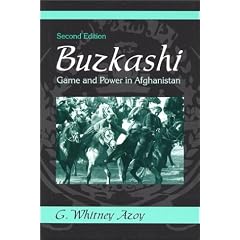
Afghans don’t play baseball. They have their own game, Buzkashi, which literally means ‘grabbing the goat’. Afghanistan’s aggressive national sport is played widely in Central Asia. Usually 20 –50 horses and riders take part in a wild kind of rugby on horseback.


G Whitney Azoy, a US foreign service information officer in the 1970s, studied the game and eventually his PhD was published ‘Buzkashi: Game and Power in Afghanistan’ (Univ of Pensylvania, 1982). His is one of the best descriptions:
‘Horsemen struggle over a mutilated calf carcass. Great clouds of dust rise from the ground as powerful horses lurch and rear, kick and bite, in a frenzy of charges and counter charges. Whips clenched in their teeth, the riders lean down and grab at the calf, wrench it clear and determine who can control what may be the wildest game in the world’


Originally introduced by the Mongol hordes of Central Asia, it evokes images of Genghis Khan, who swept throughout the region, decimating the population. The historian Louis Dupree, writes that these nomads ‘used prisoners of war instead of goats, dismembering the hapless creatures and reducing them to a mass of hominid jelly during the play’ Nowadays it is the carcass of a goat or calf, soaked in water for a few days to toughen it .

His wife, Nancy Hatch Dupree in her classic Tourist guide to Afghanistan (1970) writes more poetically
‘The tremendous skill and electrifying excitement engendered by daring riders atop glistening horses, sometimes galloping flat out, sometimes rearing with flailing hoofs above an opponent, make the game irresistibly compelling’
Irresistibly compelling it certainly is. I first saw a game being playing in Khorasan refugee camp in Peshawar in 1995. It was wild, exciting, chaotic, exhilarating, uninhibited, engaging, incomprehensible, uncontrollable, mystifying. A world apart from the rules of the familiar ‘west’. It belonged to another time and place.

Play, Parable and Paradox

Buzkashi is foremost a game played enthusiastically by the wild horsemen of Central Asia. But it is also a sort of a parable. According to Afghans ‘If you want to know what we’re really like, go ands watch a Buzkashi match’.

Roland and Sabrina Michaud have managed to capture magnificent images of Afghanistan. Perhaps none more so than their ‘Horsemen of Afghanistan’ ( Thames & Hudson 1988)
‘But is game the right word?’ they ask ‘It is a ritual, a celebration, a test of courage, strength and skill on the part of both man and horse. It is the culmination of years of training, a symbolic struggle that has all the power of drama and all the heart-stopping excitement of athletic prowess . It is a sport of individuals not teams’
It symbolises much of what it means to be Afghan, with the elite riders, or chopendoz, enjoying the status of national heroes .

It has therefore become a favourite metaphor both for the Afghan character and for the present power struggle inside Afghanistan. Afghanistan is the Buz, the goat, that has been torn apart by teams from Britain and Russia in the Great Game in the 19th century. By Russia, America, Pakistan and Saudi Arabia during the latter part of the 20th century. And now, yet again, by America and Britain in the ‘War on Terrorism’, the so called ‘first war of the 21st century’.

Sir Alexander Burnes (Cabool, 1834) around the time of the first Afghan War, observed
‘The rapidity with which the goat sometimes changes masters is very laughable; but the poor animal is occasionally torn to pieces in the scuffle’
As in Buzkashi, individual actors struggle for control and gain it only for as long as they can hang on. So with modern Afghanistan, individual commanders and regimes have held on for periods of time. The problem is it has been destroying the country. The current allied bombing is completing the job.


Power struggle
Although the game may appear like an anarchic melee, George Arney, the journalist, writing at the time of the Russian withdrawal, suggests
‘Buzkashi does have rules, not least of which is that there are 2 teams of roughly equal size, whose players are all invited to participate. After 10 years in which Afghanistan itself has become the headless goat, torn and ripped apart by contending foreign powers, it is time for the Afghans to be left to play out their own power-struggle and their own national destiny according to their own rules’
‘Afghanistan: the definitive account of a country at a crossroads’ (Mandarin 1989)

Indeed they were left to play, more deserted, by the west after the end of the cold war. This has been a bone of contention and a source of some of the Taleban’s current enmity with the West. Another 10 years on, after the Russian withdrawal, Afghanistan is again at a crossroads. The power struggle continues. Afghanistan must be left alone. Afghanistan needs help. That is the paradox. Assistance not interference.

Whatever form a government takes, post America’s ‘War on Afghanistan’, the Afghans themselves need to ‘play the game by their own rules’. Buzkashi not Baseball.


Wednesday, September 22, 2004

Damascus Tears September 2004


Barbara negotiating Frisky’s release from Damascus

Their youngest child had left his pet dog, ‘Frisky’ in a hotel when they transited Damascus. Many tears had been shed and emails sent. Our mission (‘should we choose to accept it’) was to rendezvous at the hotel in the Kurdish quarter and make the exchange. Numerous phone- calls and a mad taxi ride took us to our destination. Frisky was there in the reception, hanging tortuously by his collar.The hotel owner released Frisky, but then whisked out a calculator and forced him to calculate the cost of his own prolonged stay. ‘Another week and we would have made him a Syrian citizen’ quipped his guard. But now he was, at last, free to go. You can imagine the relief experienced by all, when Barbara later reunited him with his owner back in UK. ‘When I see that child, and the look in his eyes, that’s all the thanks that I need’. It brings a whole new dimension to understating the vital work of ‘setting captives free’ !

Damascus is one of the oldest inhabited cities in the world and we went on a walkabout to get a ‘feel’ of its oriental delights. We were travelling with Aziz, one of our regional advisory group, who himself originates from Mosul in Iraq, a near neighbour. We met some fascinating (and literate) people. In a local Kebab restaurant, the gregarious owner quoted Freud among his many jokes and later the night-watchman, in the Orthodox hostel we were staying in, confessed to reading Nietzsche and Shakespeare, which seemed to feed his own internal angst. Aziz spoke to him for hours in Arabic, whilst I spoke with him briefly in English and left them to it.


A street called straight 


We went on another trail – a sort of church crawl – in search of the lost Anglican church. It was definitely on the wall-map I spotted in the Franciscan Church of Anayas. But our search revealed there is no such church. But we visited many on the way, down narrow cobbled streets – St. Mary's Greek Orthodox, on the Street called Straight; the church commemorating Paul being let down over the city walls in a basket; a mass in a Chaldean Catholic, presided by a priest we also met in the mosque; the Syrian Orthodox (where everyone knew Aziz); an Armenian church with an erratic mass of cables overhead; and finally the 'Injeeli' Presbyterian (which the map makers had confused with Anglican). Mind you, the Bishop in Jerusalem does have plans to build a church in Damascus, at the invitation of the president. Possibly on the commonwealth war graves commission lot, between another Franciscan church and a mosque. 
We certainly had an ecumenical feast that day.

But it is the old city itself that is magnetic. The covered bazaar, street vendors, restaurants and cafes. Lots to distract and tempt even experienced travellers. The Old Souq is a shoppers delight. Good prices are to be had by a persistent barterer.


Saladin's statue, outside the city wall, dominates the area and commemorates the ‘liberation’ of Damascus, his victory at the Horns of Hattin and subsequently Jerusalem in 1187. Whereas there was unmitigated slaughter of Muslims, Jews and Orthodox Christians, accompanying the Crusader’s capture of Jerusalem in 1097, Saladin retrained his men at its recapture.


Saladin liberating Damascus and triumphing over his enemy King Richard. Their relationship is explored ‘Warriors of God’ by James Reston (Doubleday  2001) the more civilised Saladin comes out streets ahead of his ‘barbaric’ rival.


Through the Souq itself, is the Omayyad Mosque, built in 705 on the site of a Cathedral. It contains 2 tombs for Saladin – one commissioned by Kaiser Wilhelm II after his visit in 1898 for whom he was something of a hero. There is also a large tomb inside the mosque – the mausoleum of Head of John the Baptist. A group of pilgrims from Gujarat was visiting with a tour guide. I chatted with them in Urdu and suggested to them that John the Baptist pointed the way to the Christ. 


The Old Damascus mosque also has what is called the Jesus Minaret. According to the shopkeeper in the ‘Jesus Minaret Souvenirs’, who Aziz spoke to, this is where Christ will return ‘and the first thing he will do is destroy all the crosses on the churches’. The cross remains one of the biggest stumbling blocks to Muslims.


We met with Eldon and Jane, a Mennonite couple from Kansas and Cairo who are a seeking to be ‘faithful presence’ in Damascus, supporting the ancient through church teaching English at the seminary. and peace-making and bridge-building. In their charming house in the Old City, with its courtyard in middle - facing inwards, we sipped tea and cookies.

He introduced me to the Lebanese writer Amin Malouf: ‘The Crusades through Arab Eyes’ (Saqi, 2004). He talks of the ‘tears of Saladin’, his response when confronted with the news of the death of a friend and also when faced with a widowed ‘Franj’ (the generic Arabic name for crusaders) who had lost her baby. He comes over as compassionate, as well as a brilliant military strategist.

But the book also indicates just how deep rooted are the feelings and how alive the ‘Crusades’ are as a metaphor: 
Today on the eve of the third millennium the political and religious leaders constantly refer to Saladin, to the fall of Jerusalem and its recapture In the popular mind, and in some official discourse too, Israel is regarded as a new crusader state’ (265)
Over the centuries, many tears have been shed by widows and orphans in this part of the world. Manouf concludes: ‘
The Arab East still sees the West as the natural enemy. There can be no doubt that the schism between these two worlds dates from the crusades, deeply felt by these Arabs, even today as an act of rape.’ (266)


From your own correspondent

September 2004


Friday, September 17, 2004

The Metropolitan and the Mufti Aleppo Sept 2004


Christians are better off in Syria than anywhere else in the Middle East. Other than Lebanon, this is the only country in the region where a Christian can really feel the equal of a Muslim – and Lebanon of course has many other problems. In Syria there is no enmity between Christian and Muslim. If Syria were not here, we would be finished. Really. It is a place of sanctuary, a haven for all the Christians; for the Nestorians & Chaldeans driven out of Iraq, the Syrian Orthodox and the Armenians driven out of Turkey, even some Palestinian Christians driven out of the Holy Land by the Israelis. Talk to people here and you will find that what I say is true’

Mar Gregorios in Dalrymple’s book 
From the Holy Mountain (Flamingo 1998) page 150

When William Dalrymple, author of the ‘From the Holy Mountain’ met the Metropolitan he described him as a
‘small round figure’ who walked in backwards telephone in hand, talking animatedly ‘He turned a pirouette and advanced towards me his free hand extended. He finished his telephone call, snapped shut the phone with a flick of his thumb and popped it into his cassock pocket.’ He then showed him some architects plans and blueprints that were on a table.


The scene was almost exactly re-enacted for us. Archbishop Yohanna 
Ibrahim showed us plans for an old people’s home in the new Syrian quarter – on 7537 metres of land given by the government. The blue print had 4 floors of hospital and 2 floors of an old peoples’ home. ‘How can CMS help with the construction?’ was the implied question.

Christians are a sizable presence here. Christians are now around 5% of the population but at one point there were as many as 50%. There are 11 denominations: 6 of them Catholic and many churches. The Syrian Orthodox church is growing and rebuilding itself, even though many are still leaving for the West. ‘But Syria is still a place where a Christian can feel an equal citizen with a Muslim.’ the Archbishop assured us. 

Like so many in the region, the archbishop hospitably dropped everything to show us around his diocese. 

Our tour included 2 Schools, a Clinic, a Hospital and a Church.First a private co-ed school - Ben e Talub – which has 800 primary students in years 4 to12, around 300 of them on scholarships, supported by World Vision. According to the register, the St Ephraim dispensary saw 17,164 patients in 2002. It is a converted old ‘Bohemian’ house in popular city centre, where about 25 are treated and a further 25 referred per day. While we were there, a young Muslim woman in Hijab (head covering) was visiting the dentist, whilst she happily let her baby be looked after by the Christian staff. 


At the second dispensary, in the Syrian quarter of Hay Sulemania, a dentist and a general medic see around 5000 patients per annum.The Diocese also has a Hospital, started by Dr. Altonian in 1918. He is famous for bringing the first X-ray to Syria. We saw a display case of old instruments, including gold nails for orthopaedic work and ivory ophthalmology instruments.A nurse was nursing her father who had recovering from a RTA. Another Armenian nurse ran the gynae ward. The hospital had 2 operating theatres, a delivery room and an ophthalmic theatre.


In Azizi the Church of St George celebrates the story of King Abgar. He wrote to Jesus to come and heal him. According to tradition, Jesus sent one of 70, the disciple Adai, with the‘Mendellion’, a face cloth, which produced the necessary miracle and healed the king. This became the first principality to be baptised Christian. 


The church has an attached school, built with $ 1/4 million, donated by a parishioner in Belgium. ‘It was reburbished a week ago. We are still getting organised’ explained principal Sarah Ghramji. CMS-Interchange may be able to arrange for her to visit schools in UK to help improve the standards. Not so much investing in buildings, but more in people.Mar Gregorios was apologetic: ‘We have everything here, but on a small scale’. He certainly has big vision.


'The Mufti of Aleppo'   Ahmad Masoun


“Once a child asked me ‘why does religion came from hot country ?’ I told him it was to raise the temperature in the cold countries!”


The Archbishop took us to meet the Mufti. ‘Pepper and Salt’ I called them. His house had a special reception room for guests – with chandeliers and walls lined with bookcases, full of Islamic books and treatises. ‘Mufti’ means the ‘one who gives interpretation’. His base is the mosque of Rowda garden where 30-40,000 go to listen to him in mosque. With the recent death of the Grand Mufti of Syria, he is a possible candidate. He was charming, open and full of hope, good news in the midst of so much bad interfaith. Over honeyed tea, he spoke of many things. About the need for real dialogue - not just a constitutional dialogue. Aleppo is a good example of this. Inter-faith is in the open – it’s on the street. The two faiths work closely together.

Syria and Palestine are the seed-bed of religion. The prophets came from here – It is the place that God chose.Christians, especially Arab Christian, have a lot to contribute –‘It was a fatal mistakes to evacuate minorities from the area’…‘Christians and Muslims have been brought up here as brothers, We even shared the same wet nurse….Local mothers feed each others babies.’
There is an old old tradition of Mariam's feast (sufra) to remember Jesus birth, because there was no one there to celebrate, when He was actually born. ‘So we also celebrate today, as Muslims. This is a tradition my grandmother taught me.'


There was great openness between the faiths until the Zionist state was formed. Then it went bad…This ‘clash of civilization’ is not of God. Religion does not clash in itself. Although Protestant religion is ‘man-made’, he corrected ‘they use the Bible as a front - But there should be no fight between two prophets. The war in Iraq has severely damaged co-operation. Everyone knew what would happen. I said you must think before you open fire…this fire will burn you… it opens the doors to hell. It is always more difficult to rebuild than to destroy. The key to hell is in the hands of politicians: the key to heaven is in the hands of religious leaders.


We always pray for Palestine, but together the politicians seem determined to keep the door of heaven firmly closed. The Sons of Abraham should not be teaching animosity and war! My hope is that pain will cause people to return for healing, but are we ready to comfort the people as they return to God?

He was very happy and proud and most encouraged by the example of men of faith. He sent warm greeting to the Archbishop of Canterbury, together with Prince Charles, especially appreciating their stand and statements in the arena of interfaith. ‘But not to all religions leaders in Britain’ he added, ‘some are failures!’ His parting message to the people of the UK, who keep carrying the message of peace:
‘‘if the flames continue, everyone will catch fire… we can only extinguish them by light.’


The Mufti showing a model of the Kaaba. - He has suggested that, in the spirit of openness, Christian groups should be allowed to visit. Maybe this will be the first ‘Praxis Mecca’ !


The Archbishop of Aleppo’s words about coexistence certainly seemed true. The Syrians Christians we met appear to experience refreshingly good relations with Muslims. But the last word goes to our driver, Raymond, an accountant who recently returned from Saudi.
‘We have a good future between the religions. I have seen it with my own eyes. We do not need to leave. His eminence is giving us a good hope’.


From your own correspondent
Aleppo: Sept 2004

Monday, September 13, 2004

‘Lift Jesus higher’ on Mount Nebo Jordan Sept 2004

Mount Nebo Siyagha Memorial of Moses (Christian Holy Place)


On Moab’s mountain - Mount Nebo - overlooking the Dead Sea and Jordan valley, where Moses died (Deut 3:27, 34: 1, 5) there is a cross, designed by the Franciscans, which is simply stunning. Go up into the Abarim Range to Mount Nebo in Moab, across from Jericho and view Canaan the land I am giving.’ (Deut 32:49) This is where Moses saw a glimpse of the Promised Land before he died (Deut 34:10)This memorial of Moses is part of the monastic work of the Terra Sancta. The Franciscans acquired the ancient site in 1930s and other than an interruption during WW2, continued work on the monument until the 1960s, when it took its current form as a site of tourism and pilgrimage. Much is made of the Popes visit in 2000. Postcards are readily available.

But even in the 5th century Peter the Iberian reports:
‘All the inhabitants of that region together hurriedly brought building materials; this temple was built in the name of the great Prophet and Lawgiver, and he proclaims publicly to every man and so that no doubt is possible his goodness and power by means of signs and wonders and cures, which since that time have occurred at this place without interruption. For it is a place of cure both for the souls and for the bodies, and a place of refuge for all those who come here from all places and are afflicted in soul and affected with many kinds of sufferings of the body’    (Michele Piccirillo Custodia Terra Sancta Jerusalem)
The 6th/7th century Basilica is peaceful and cool with impressive mosaics and chapel. Malcolm and Veronica’s congregation have their Easter Sunrise service and breakfast in the chapel and grounds. A magnificent setting to celebrate the Risen One.


But it is the Cross made by Italian artist Giano Paolo Fantoni that drew me. Representing both Moses’ snake (Num 21 8-9) and the crucified Christ. Beneath is written in Arabic the text of John 3:14. I asked a lady to read it for me
‘Just as Moses lifted up the snake in the desert so the son of man must be lifted up’
It is in a prominent position. People stand and look over the plane below. One old man in mourning black, searches through binoculars for reminders of the past – maybe even looking for his home, now in occupied territories. And a young woman in jeans stands with hands held open in supplication. Mouthing prayers of intercession.

It is an impressive symbol, stunning, overt, not subtle. Not what I have come to expect in this region. I was left wondering how we can lift Jesus higher, so that people are drawn to him - ‘But I when I am lifted up from the earth will draw all men unto myself’ (Jan 12: 32) Is this just talking of the cross, which is such an anathema to the majority population in this region of the Middle East. Or are there other ways of lifting Jesus higher, even in this difficult context. Maybe this Franciscan cross is the clue and that healing, signs and wonders is the key. Plus dedicated Franciscan service. 

As we were leaving we looked again at the cenotaph, a huge Monument of Stone, reminded us: ‘God is Love’ in Arabic. Here in the Bible Lands ‘even the stones cry out’.


From your own correspondent
September 2004

Thursday, May 20, 2004

Reflections of an itinerant Board member Kabul May 2004


Yemi, ‘blending in’. He accompanied on a trip to Pakistan and Afghanistan in Feb 2004. He certainly has a sense of humour, which helps 

BORED MEETINGS ?

One of the things I do when I travel is attend board meetings. That’s B.O.A.R.D. not B.O.R.E.D ! As a result I have been thinking a lot about their purpose and function.

I have also been thinking about the power of words. God created the world through his word. He spoke things into being. Words are powerful and we too create reality through the words we use. So we need to think carefully about our words and their meaning and their effect. And particularly use positive, appreciative words, that build people up rather than cut them up.

Words are fluid, rather than solid. Meanings change with time and context. We use words differently. They are not fixed in their meaning. This is especially true in organisations with people from many nations and cultures.

For example in one organisation I visit we used to talk about ‘training’ but then some people pointed out: ‘you don’t train people, you train dogs!’ The meaning has changed. So these days we talk more about ‘capacity building’. That is not just faddish, but an attempt to reflect changes in attitude and meaning.

The meanings of words are partial and incomplete. People give meaning to words and can co-construct reality through them. Policy is an attempt to capture meaning, and create structure and boundaries that are workable. It is about liberating people to act, rather than restricting action. A board is not there to dictate, but to advice and offer guidance It is responsible for ‘policy governance’ not management. That is the leadership’s job - the directors and managers of the organisation.

A board is the overall guardian of the mission of the organisation. It works on ‘broad policy guidelines’ ensuring that policy is in place, approving the detail work that has been delegated to others to do. It meets infrequently, (often only once or twice a year) and just hasn’t got the time to do all the detailed work.

So instead, in the board I chair, we seek to create space to talk about the ‘big issues’ We are experimenting with way of interacting with the field leaders about their ‘departmental plans’ rather than just receiving loads of paperwork.

Policy in organisations is about negotiation and about compromise. In a sense policy making is drawing a line in the sand. And sometimes the lines need redrawing. It is always ‘work in progress’

Organisations are complex and diverse. There are many people and many voices that want to be heard. It is about living with difference. Trust is needed and patience. We all work within time constraints. And people can easily be hurt. So we need much understanding, flexibility and balance. Plus, of course, a sense of humour.


One day the people asked Mullana Nusraddin ‘Why is it that in the morning some people go off in one direction and other people go off in the opposite direction?’ Nusraddin thought for a moment and then responded: ‘If everyone went in the same direction the earth would lose its balance!’


From your own correspondent:

Kabul, May 2004


Wednesday, April 14, 2004

‘Sowfall Innit !’ South London April 2004

‘Sowfall Innit !’


I was attending a meeting at St John's Church, which included a look at the area – a walkabout Southall. The Old Parish Church is now the ‘St John’s Young Peoples Centre’ sited on the corner of Weston Road and King Street, between a small ‘square’ with a statue of a ‘Henna Hand’ complete with seats and pigeons and the old church hall which is now a Hindu Temple, with plans for impressive improvements.Built around 1840, the Church looks old and unused in the midst of a derelict graveyard. There is a plaque high on the door with a ‘Church Lads and Church Girls Brigade’ shield. A large, blue explanatory Notice Board proclaims ‘The Parish Church is St John’s in Church Avenue (opposite) You & your family would be welcomed at Sunday Services. Morning Service at 11.00 am Asian Christian Fellowship at 4:00pm Evening Service at 6:30pm. See notice board in Church Avenue for details’


New St Johns was built in the early 1900s to cater for the increased number of Railway workers from Wales and Ireland. It is more friendly ‘A Parish Centre’ with a clearly evangelical board ‘One Church One Lord JESUS CHRIST Worship Him here’ Church Avenue is a cul de sac, fairly inaccessible, but the back entrance on Havelock Road hosts the largest Sikh Gurdwara in the country.Southall is a very mixed ethnic area. The new Rector of St John’s, Rev. Mark  has been in the area for just over a year. He informed us that in the Parish of 23 thousand, there are 7000 Sikhs, 4000 Muslims and 3000 Hindus.Kenyan, Sierra Leone. Whilst the Sikh Gurdwara dominates there is a significant mosque of 1500 around the corner. Traditionally the largest immigrant communities were from North India and Pakistan. As these moved out they are being replaced by new groups from Afghanistan, Kosovo, Central Asia, Iran and Iraq. Southall is a vibrant, rapidly changing community.

Rev Mark emphasized the importance of a Christian Presence in such an area. His congregation is itself mixed, including a lot of Asians who came during the ‘white flight of the 1960s’ The parish is involved in running language classes for Afghans, Somalis, Tamils and some Iranians. They run ‘masala groups’ with an emphasis on hospitality; and have a vision for health care and pre-school work.


Dave and Ann Bookless, also based at St Johns run a ‘Christians in Conservation’ project called ‘A Rocha: Living Waterways’. Launched in 2001, it has ‘a vision for environmental renewal and community regeneration’ in Southall and Hayes, which includes a Country Park, Environmental Education Project, Nature Reserve and Floating Classroom’


A Rocha is hoping to move its offices to a new development - the gasworks site where the council is planning to build 4000 homes on 70 acres


I had been to Southall before to the Kings Hall Methodist Church - on other side of railway - to visit another partner organisation ‘CLAAS’, run by Pakistani, Nasir Saeed. They advocate on behalf of the persecuted Christian minority in Pakistan. Impressive and necessary work.


Walkabout

We continued our walkabout. Up past Southall Baptist Church and Christian International Community centre; then a derelict pub ‘The Bricklayers Arms’ up for sale. Past Featherstone school, a large, 60s-looking comprehensive school, with its huge gates ; then the Central Mosque ‘None to be worshiped but Allah…. Mohammad is his prophet’


The King Street / Hammond Street crossroads is fascinating. A sort of interfaith cross-roads. On one corner a Car park with access to both Southall Church of God and Guru Nanak Darbar. On Kings Street a row of Asian shops: ‘Sunrise Bakers’ specialists in Birthday and wedding cakes; ‘Pooju Wooji’, specialist design wear; ‘Reena’s’ Wholesale and retail; ‘Two Tel Telcomms’ Low cost International and local calls; and ‘A £OUND OR TWO’ - a cheap sell everything type of market shop.


On Adelaide Road the ‘HSBC’ Bank built 1903, representing the god of mammon, and on Norwood Road an boarded up building the ‘Site for Sri Gura Amarddass Gurdwara’. Down Kings Street, Fiona and Tony’s Irish Pub ‘the Black Dog’ seemed strangely out of place in this little corner of Asia.


See full size image
Most people living in the area work in 'Heathrow city' but have an ambivalent relationship with the Airport which brings prosperity, but is also fundamentally changing the environment. The Green is the main thoroughfare to the Railway station. There is a well used community centre, a large Office block which Ealing borough council is converting to the largest public library in London. Past an Afro Caribbean Music Hall and dance centre to St Anselm's Catholic Church and Parish Centre. Just down the lane, past a power station that looks like a railway signal box. There is a Somalia Social centre. This is in an area now dominated by Somalis and Kosovans.

On the other side of the road a War memorial fronts Osterely Park, on the left an old park building and on the right the oldest building in Southall a Tudor Mansion now used by the council. ‘In grateful memory of our local heroes who gave their lives in the Great War 1914- 1918 1939-1945’ There was not the usual list of names of fallen comrades.


Later we went to the main shopping area in Southall, past a Bollywood style cinema emporium and found some arcade shops. Opposite the ‘Kabul Restaurant’ was an Afghan music shop. I was able to talk to the guys there in Dari. They were delighted to meet someone who had been to Kabul, Mazar-e-Sherif and Jelalabad, where they all came from. They jokingly told me that I should also visit Kandahar to meet the Taleban ! (They are in UK because they fled that very regime during the war years). We had a good, albeit brief, time - a friendly connection was made. And they presented me with a CD of Afghan music as a keepsake. ‘Don’t forget to visit Kandahar’ they joked as I left. I wondered if this is what is meant by 'doing inter-faith in Sowfall' ?


From your own correspondent

South London April 2004

Thursday, April 01, 2004

Positive Testing Romania April 2004

POSITIVE TESTING  - AN APPEAL FOR HELP 

Enriut knew he had a blood problem and that he needed help, but the nearest testing centre was over fifty miles away. After his long despairing journey, his worst fears were confirmed. He had tasted positive. He told his friends about it and they were totally shocked.
“We just don’t talk about these things. You’ll lose your friends if you do. Nobody understands about this blood problem, just pretend it’s a cough.”

Enriut is one of hundreds of people with this serious blood problem in this part of the region and CMS and its local partner are trying to raise awareness as well as setting up local blood testing centres, so that people like Enriut do not have to live in darkness in this remote part of the country.

Will you help this vital and vibrant project in Transylvania? - in the wild and remote hinterland of Romania, as part of an unorthodox alliance between CMS and the Orthodox church.

We desperately need to develop a new remedy. ‘
The Garlic sauce is just not working’
says CMS Mission Partner, Frank N. Stein from the Wurtenberg Church in Germany.
‘We want people to be able to drink from the fountain of immortality’

“He coughed constantly but there was still the old spark in his eyes.”


Your gift of just £36.19 will help keep Enriut and his friends from a fresh supply of blood for a month. DO something NOW! You CAN make a difference!!


From the Fundraising team of
Carpathian Mountain’s Salivation (CMS) Project

Friday, March 26, 2004

Constantinople and the Crusades March 2004

Constantinople and the Crusades


‘so much courage, so little honour’
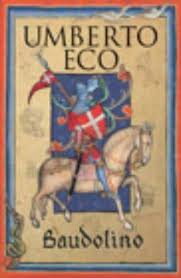
I have been reading around the Crusades as I have been travelling – they hold a fascination for me - Umberto Eco’s latest novel ‘Baudolino’ about the forth Crusade, under Barbarosa and the Frankish invasion of Constantinople (1204) 


This  weakened the city and contributed to its collapse and paved the way for the eventual Turkish / Selcuk takeover, under Sultan Mehmed II (the Conqueror) on 29 May 1453.


The determination of the westerners to conquer and colonise the lands of Byzantium was disastrous for the interests of Outremer. It was more disastrous still for western civilization. Constantinople was still the centre of the civilised Christian world. In the pages of Villehardouin we see reflected the impression that it made on the knights that had come from France and Italy to conquer it. They could not believe that so superb a city could exist on earth; it was of all cites the sovereign. Like most barbarian invaders, the men of the Fourth Crusade did not intend to destroy what they found. They meant to share it and dominate it. But their greed and their clumsiness led them to indulge in irreparable destruction….
Georges Tate ‘The Crusades & the Holy Land’ (1996,Thames&Hudson)

The Crusades that initially were meant to be all about liberating Jerusalem from Islam, in the complexity of the Middle East, became a pretext for the occupation of a ‘Christian’ city – Constantinople. It is a challenge that feeds into the current context, a sobering warning with Bush’s current ‘crusade’ against Terror, and those nations that harbour terrorists. Saddam Husein was seen by many Muslims as modern day Saladin. And Israel is perceived to be a crusader state. There is a real danger of polarisation, Crusade and Jihad. And a need for much wisdom and openness to dialogue.

The triumphs of the crusade were the triumphs of faith. But faith without wisdom is a dangerous thing. By the inexorable laws of history the whole world pays for the crimes and follies of each of its citizens. In the long sequence of interaction and fusion between Orient and Occident out of which our civilization has grown, the crusades were a tragic and destructive episode. The historian, as he gazes back across the centuries at their gallant story, must find his admiration overcast by sorrow at the witness that it bears to the limitations of human nature. There was so much courage and so little honour, so much devotion and so little understanding. High ideals were besmirched by cruelty and greed, enterprise and endurance by a blind and narrow self-righteousness; and the holy war itself was nothing more than a long act of intolerance in the name of God, which is the sin against the Holy Ghost’
Steven Runciman ‘A history of the Crusades’ vol 3 (1954)
Mission is also in the mind. It is about right attitudes as well as right action. But we need a ‘crucified mind, not a crusading, or coercive mind ‘ Mission is about ‘crossing boundaries, not crushing them.’ It is about serving, not sacrificing people.
Kosuke Koyama (1974) What makes a missionary ?

In the words of the protest song: ‘when will we ever learn, when will we ever learn?’

From your own correspondent

March 2004


TURKS: Journey of a Thousand Years, 600 - 1600

The Royal Academy of Arts has an Exhibition running from 22nd Jan – 12th April 2005 called
Turks: a Journey of 1000 Years - 600-1600 AD


Friday, January 16, 2004

RICHARD PENNER, KIA, Uzbekistan, January 13, 2004


RICHARD PENNER

Seattle Times 
Mennonite Brethren Herald

I had just come out of an all day Director’s meeting to hear the devastating news of Richard, the field director of World Concern, who was based in Afghanistan. The email read: ‘killed in a domestic plane crash in Tashkent Uzbekistan on Tuesday evening, Jan 13th, 2003’.

I sat at my computer in stunned disbelief for a long time. I was not able to keep back the tears. I remembered when I briefly heard the news, on the radio, of the air crash, wondering if anyone I knew was on it, but then thinking that the only person I really knew who had been in-country was Richard and he’d moved to Mazar-e-Sherif, so he couldn’t have been be affected!

He was a dear brother, with a wicked sense of humour and I will miss his wise contributions (and his not so wise, but witty ones!), borne out of years of experience in the field. He was doing a very similar job to me and we were together last November for meetings in Kabul. On that occasion he travelled with his wife, Ann and we’d all had a wonderful time of sharing and good fellowship (and good food) in a friend's house. We easily forget how precious, fragile and fleeting these moments are. I kept thinking it could so easily have been me, it could have been any one of us who travels frequently to board meetings around the world. It got to me very deeply indeed.


I have a prayer from Russia above my desk at work and my eyes were drawn towards it - particularly the second stanza - I share it with you all. It has become my prayer for Regional staff


The prayer of the last monks of the Optina Hermitage

Lord teach me to meet with peace of mind and spirit
All that the coming day has to bring me.
Help me to devote myself entirely to Your Holy Will
Guard and instruct and countenance me,
throughout every hour of this day.

Whatever the news that I receive today,
Help me to accept it in the calmness of my soul
And firm conviction that all is sustained by Your Holy Will.

In all my deeds and words –
be the leader to my emotions and my intentions
In the unforeseen consequence – do not let me forget
That you are the sender of everything

Teach me how to relate to my fellow brothers and sisters
Open and wisely and without hurting or confusing anyone

O Lord give me strength to endure
the fatigue of the coming day
And all the events that are due to unfold today.
Guard my will and teach me
To pray, to believe, to endure,
to forgive and to love. Amen