
Rudyard Kipling immortalised it in Kim. The Russians called it the ‘Tournament of Shadows’. But it was Captain Conolly of the Bengal Light Infantry who first coined the term ‘The Great Game’ to describe the shadow play of British and Czarist agents across Central Asia as the Russian frontiers pushed closer to India. Peter Hopkirk describes it well in his book of the same name, as well as his ‘Setting the East Ablaze: on Secret Service in Bolshevick Asia’ (OUP)
The area known as the Northwest Frontier of Pakistan is steeped in history. The Khyber Pass is lined with Regimental shields commemorating those who have fought and died in 3 Afghan Wars. This is where Churchill (as recounted in ‘My Early Life’), a war correspondent took pot-shots at Hill Tribeman at the end of the 19th century. Untamed by the British Raj, it was a final outpost of the Empire before the Durand Line, running through Afghanistan along the line of the Oxus River (now the Amu Darya) separating the ‘British Lion’ from the ‘Russian Bear’. The Great Game has been played throughout this Central Asian playing field. Full of romanticism, adventure, treachery. Boy’s Own country.
The area known as the Northwest Frontier of Pakistan is steeped in history. The Khyber Pass is lined with Regimental shields commemorating those who have fought and died in 3 Afghan Wars. This is where Churchill (as recounted in ‘My Early Life’), a war correspondent took pot-shots at Hill Tribeman at the end of the 19th century. Untamed by the British Raj, it was a final outpost of the Empire before the Durand Line, running through Afghanistan along the line of the Oxus River (now the Amu Darya) separating the ‘British Lion’ from the ‘Russian Bear’. The Great Game has been played throughout this Central Asian playing field. Full of romanticism, adventure, treachery. Boy’s Own country.
Now the Americans are involved. But it is not romanticism but a ‘war on terrorism’. They are even talking of a ‘Game Plan’ in Afghanistan. The wealthiest and most powerful nation against one of the world’s poorest. The McDonald’s Empire versus the local chai-khana (Central Asian tea shop). Or maybe more appropriately Baseball league versus Buzkashi.
Buzkashi : ‘the wildest game in the world’
Afghans don’t play baseball. They have their own game, Buzkashi, which literally means ‘grabbing the goat’. Afghanistan’s aggressive national sport is played widely in Central Asia. Usually 20 –50 horses and riders take part in a wild kind of rugby on horseback.
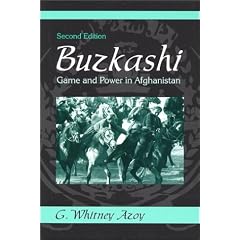 G Whitney Azoy, a US foreign service information officer in the 1970s, studied the game and eventually his PhD was published ‘Buzkashi: Game and Power in Afghanistan’ (Univ of Pensylvania, 1982). His is one of the best descriptions:
‘Horsemen struggle over a mutilated calf carcass. Great clouds of dust rise from the ground as powerful horses lurch and rear, kick and bite, in a frenzy of charges and counter charges. Whips clenched in their teeth, the riders lean down and grab at the calf, wrench it clear and determine who can control what may be the wildest game in the world’
Originally introduced by the Mongol hordes of Central Asia, it evokes images of Genghis Khan, who swept throughout the region, decimating the population. The historian Louis Dupree, writes that these nomads ‘used prisoners of war instead of goats, dismembering the hapless creatures and reducing them to a mass of hominid jelly during the play’ Nowadays it is the carcass of a goat or calf, soaked in water for a few days to toughen it .
His wife, Nancy Hatch Dupree in her classic Tourist guide to Afghanistan (1970) writes more poetically
‘The tremendous skill and electrifying excitement engendered by daring riders atop glistening horses, sometimes galloping flat out, sometimes rearing with flailing hoofs above an opponent, make the game irresistibly compelling’Irresistibly compelling it certainly is. I first saw a game being playing in Khorasan refugee camp in Peshawar in 1995. It was wild, exciting, chaotic, exhilarating, uninhibited, engaging, incomprehensible, uncontrollable, mystifying. A world apart from the rules of the familiar ‘west’. It belonged to another time and place.
Play, Parable and Paradox
Buzkashi is foremost a game played enthusiastically by the wild horsemen of Central Asia. But it is also a sort of a parable. According to Afghans ‘If you want to know what we’re really like, go ands watch a Buzkashi match’.
Roland and Sabrina Michaud have managed to capture magnificent images of Afghanistan. Perhaps none more so than their ‘Horsemen of Afghanistan’ ( Thames & Hudson 1988)
‘But is game the right word?’ they ask ‘It is a ritual, a celebration, a test of courage, strength and skill on the part of both man and horse. It is the culmination of years of training, a symbolic struggle that has all the power of drama and all the heart-stopping excitement of athletic prowess . It is a sport of individuals not teams’It symbolises much of what it means to be Afghan, with the elite riders, or chopendoz, enjoying the status of national heroes .
It has therefore become a favourite metaphor both for the Afghan character and for the present power struggle inside Afghanistan. Afghanistan is the Buz, the goat, that has been torn apart by teams from Britain and Russia in the Great Game in the 19th century. By Russia, America, Pakistan and Saudi Arabia during the latter part of the 20th century. And now, yet again, by America and Britain in the ‘War on Terrorism’, the so called ‘first war of the 21st century’.
Sir Alexander Burnes (Cabool, 1834) around the time of the first Afghan War, observed
‘The rapidity with which the goat sometimes changes masters is very laughable; but the poor animal is occasionally torn to pieces in the scuffle’As in Buzkashi, individual actors struggle for control and gain it only for as long as they can hang on. So with modern Afghanistan, individual commanders and regimes have held on for periods of time. The problem is it has been destroying the country. The current allied bombing is completing the job.
Power struggle
Although the game may appear like an anarchic melee, George Arney, the journalist, writing at the time of the Russian withdrawal, suggests
‘Buzkashi does have rules, not least of which is that there are 2 teams of roughly equal size, whose players are all invited to participate. After 10 years in which Afghanistan itself has become the headless goat, torn and ripped apart by contending foreign powers, it is time for the Afghans to be left to play out their own power-struggle and their own national destiny according to their own rules’‘Afghanistan: the definitive account of a country at a crossroads’ (Mandarin 1989)
Indeed they were left to play, more deserted, by the west after the end of the cold war. This has been a bone of contention and a source of some of the Taleban’s current enmity with the West. Another 10 years on, after the Russian withdrawal, Afghanistan is again at a crossroads. The power struggle continues. Afghanistan must be left alone. Afghanistan needs help. That is the paradox. Assistance not interference.
Whatever form a government takes, post America’s ‘War on Afghanistan’, the Afghans themselves need to ‘play the game by their own rules’. Buzkashi not Baseball.


No comments:
Post a Comment