Friday, October 14, 2005

More Earthquake updates


Mike, Project leader in Lahore 13 October 2005
There is confusion among some friends as to how I'm involved in the effort from Lahore when the affected area is in Islamabad and up north. My responsibility is to resource the relief effort, as much as possible, from Lahore aimed primarily at two Christian hospitals in the north that are in the disaster struck area. This is the immediate work I am involved in. The long term hope is to be engaged for years to come in Kashmir and northern Pakistan with a Kingdom perspective.
As you pray for our nation please pray against the spirit of greed and turning a quick buck that has gripped suppliers of goods and transport services. Prices for items like tents, blankets, medical supplies and even essential eatables have risen sharply and transportation has skyrocketed. Trucks are not available and the few that are ask for exorbitant prices. We are having to pay three times the normal and it hurts in more than one way. Unfortunately, such is human nature but as you pray I am sure God will make it possible for us to meet with men of peace who will be of assistance to us.
Tomorrow night (Friday) we will receive and send our first shipment of tents to one of the Christian hospitals up north for distribution to the victims. Our distribution is non-sectarian and almost all of those being helped are Muslims. Please pray for the shipment to arrive at the hospital safely and for effective distribution to take place.
Yvonne, English woman in Peshawar Friday, October 14, 2005
There is still a big need for more helicopters and  good weather. The Gov estimates 2 million homeless and 1 million in urgent need of help. All around Peshawar are "camps" set up by different organisations to collect goods - blankets, food, clothes etc - and money, it is clear that there is a great desire by everyone at every level to do something to help. One of my colleagues was telling us this morning how his wife said she did not want to watch any more news about the earthquake on the television - but then she donated for the victims two new pieces of good cloth that he knew she really liked and was planning to make into suits for herself. (And she will need new clothes for the end of Ramazan.) I think this grassroots feeling, among people who don't have much surplus themselves, is very strong.
I know of a couple of organisations who have sent their own vehicles in with some aid and to check on colleagues in the affected area. Several NGOs here are making surveys and putting together plans. Unfortunately many mountain roads that had been cleared of landslides became clogged with large lorries which are too heavy for the terrain, rented privately to send aid in. The church of some of my local colleagues is collecting goods and money but they are waiting until next week to check what the needs are in an area where little help is being sent. They were aiming to collect mainly from the chr community and were surprised how many from the majority also gave to them - maybe they are more respected locally than they realise.
Yvonne in Peshawar Sunday, October 16, 2005
The BBC now reports 38,000 dead and still rising, 60,000 injured, many of whom are exposed to the elements, with more rain this weekend grounding relief flights (it even rained heavily down here), and an estimate of 3.5 million homeless. It is hard not to feel very helpless. I just read about the loss of one helicopter and its crew because of the bad weather.
At the meeting this morning there was some news of what some Peshawar-based int'al NGOs are doing. 2 NGOs are working together through Bach C. Hospital, probably to get more aid to Garri Hajibullah hospital. The meeting took up a special collection for Bach. Another organisation was talking about Habitat for Humanity who are working on longer term plans for rebuilding homes. They are asking for SHORT TERM VOLUNTEERS (3 - 6 months?) with some knowledge of the culture and preferably some language, people who have been here previously - probably men - to help in this work.
I believe the Government is also planning to set up IDP camps for the homeless - including some in this area. They are desperate for tents, blankets etc. There are no tents left in Pakistan, and the Govt has lifted the import tax on them. They are appealing for tents to be donated and sent to Dubai where PIA would collect them.
Ahmad in Kabul Afghanistan Sun Oct 16
Yes, the earthquake changed things so dramatically in such a short time, which is unbelievable - so much loss and damage.... Some people here believe it is the cost of sin, but I do not know what is the truth from this point of view.  What will be your comment?  I just read that the infiltration still continue and has not stopped despite all this.... Anyway, " Mullah Nasruddin was asked, what is doomsday? He replied there are two doomsdays, small and big.... When my wife dies, it is a small one and when I die, it will be a big one” Is Mullah N. right?!
Update from CMS London 17th Oct
We are able to support medical relief work and have people associated with CMS in the area. MP Nigel has been seconded to Tearfund in Islamabad to coordinate relief work into Bagh and Dr. Ruth is returning to Bach Christian Hospital for three months. If anyone would like to donate through CMS the money can bee used to support these two people and the work they are associated with and also Kunhar Christian Hospital which is quite close to the epicentre. There will be plenty of after care needed and Church World Services Pakistan/Islamabad are already drawing up a trauma counselling programme. There will be many opportunities to explain why Christians are helping in the months to come that CMS can help to support.

Thursday, October 13, 2005

Pakistan Earthquake Oct 2005


I have been watching pictures of the terrible destruction as a result of the earthquake measuring 7.6 on the Richter scale. An estimated 40,000 have been killed across Kashmir, Pakistan and India in the early hours of Saturday, Thousands more have been left homeless and injured, and the numbers are rising.
It is very sobering indeed to think that things can change so dramatically in such a short time. A matter of mere minutes. So many killed, so many injured, so many lives changed.


I have lived in Pakistan for many years - no-one I know personally was directly affected (as far as I am aware) - but the earthquake was still a great shock.

I have already received many emails, about the situation, Here is a selection of them - brief quotes that may help you get a human feel for what people are going through, even those not in close proximity to the epi-centre itself.

Yvonne an English woman in Peshawar (Sun 9 Oct):
"It is very odd to have the ground beneath you come alive. I was at home when it happened, working on my laptop. When it became clear that it wasn't just a large lorry going past, I thought I'd better go outside, and as I was already holding my laptop I thought I might as well keep hold of it. So I just closed the lid and went outside, and then I found myself sitting on my lawn, which was moving like a raft on water, dressed for the temperature rather than for the culture, barefoot, and thinking that if my house collapsed, at least I would have the clothes on the washing line.
My water tank started overflowing because the water was moving in it, and my metal gate was rattling in its frame, and the grass I was sitting on stayed fluid for a long time - well it seemed like a long time but I suppose it was ten minutes. I'd been listening to the soundtrack of the BBC's "Wives & Daughters" while working, and the DVD carried on when I closed the laptop lid - so the company of Mrs Gaskell's characters provided a surreal touch.
After that there have been countless small tremors, some as I write this. The aftershocks are more disturbing mentally than physically, and must be very frightening for those in worse affected places."
Dr Haroon working in Kunar (Mon 10 Oct)
"The first assigment of the damage has been reassessed and there has been some severe damage to the buildings. There are huge cracks in the walls of the hospital, the nursing hostel and other appartments ...... We have spent the last two days out in the open...cooking and sleeping and everything outside. Last night at 2:30am some people arrived with tents and other aid so we are going to go out today and hand out the tents to the people. So many people have lost their houses so its going to be a huge project. We would welcome any donations, anything. These people didn't have much to begin with and now they literally have nothing. The medical staff continue to work all day helping out the survivors."
Aamir running a project in Islamabad (Mon 10 Oct)
"The death toll is feared to cross 40,000 figure, with most of the victims in AJK and NWFP. The slums in Islamabad which house around 30,000 Christians remained immune, and there is no incident of collapsed houses although many of these houses are non-concrete, made of mud and wooden planks.
One girl from these slums is confirmed dead in Margalla Towers, where she used to work as a domestic worker. There is news spread of another 10 to 12 Christian ladies missing in debris of Margalla Tower, these ladies belonged to two Christian communities. The schools in Rawalpindi and Islamabad will remain closed for three days as slight tremors are still coming at a regular frequency............The Christian Community in Abbottabad has suffered financial losses with houses partially damaged, thankfully no loss of life has been heard. However people being traumatized and fearful to stay insides have setup tents in open spaces and are there since the first shock. So far they have not received any kind of assistance from Govt. or private departments and their stocks of food are quickly diminishing."
Insar, a youth worker in Peshawar (Mon 10 Oct)
"The youth of the Diocese of Peshawar is busy in collecting warm cloths and medicines for the affected people, as we are planning to visit to affected areas to participate in the relief work. For this purpose, we need your prayer support. The Diocese of Peshawar (the affected area of NWFP come under the jurisdiction of Peshawar Diocese) is active to support the relief work. We were in the All Saints' church Peshawar today and prayed for the affected people and areas. Bishop Mano Rumalshah, the Bishop of Peshawar announced a Special prayer service in the St. John's Cathedral Peshawar on Wednesday at 5:30 pm, in which beside the Christians, our Muslim friends will also participate for praying for our affected brothers and sisters. Bishop Mano also announced to collect a fund for the relief of those people, the Christians are contributing in that fund."

Thursday, September 22, 2005

Alpha and Omega METROPOLITAN FILARET in London July 2005


The Metropolitan of Minsk, the No 2 in the Russian Orthodox hierarchy, has a long Gandalf-white beard. He was on a 4-day programme visiting potential partners, ‘dignitaries’ and VIPs in UK. As well as a visit to the CMS office, he also visited the Archbishop of Canterbury. Timothy Okroev, my Russian Orthodox colleague. On this occasion, as well as our Regional Manager, he was acting as interpreter and guide.


The group visited the Archbishop of Canterbury, Rowan Williams, a key figures in the official Orthodox-Anglican Dialogue. The Archbishop, as its Patron, encouraged CMS to also support the Orthodox Church in Belarus in its theological education, evangelism and ministry to the poor.


Alpha at HTB

The Metropolitan also went on to a meeting with Alpha at Holy Trinity Brompton (HTB): My colleague Timothy writes:

'We had a meeting with Sandy Miller and Nicky Gumble joined by father Evmeniy from the Russian Orthodox Church.
HTB told the metropolitan more about Alpha and how it contributed to the spiritual revival in England, attracting a lot of young people. As a result of this meeting Metropolitan Filaret instructed father Evmeniy to study the “Alpha phenomenon” and report to the Holy Synod. It may well be that, once the report is completed Evmeniy will become the person to be officially entrusted with developing Alpha in the Orthodox context. This is probably one of the greatest outcomes of Metr. Filaret’s visit to England. After the meeting with the two Alpha gurus, the metropolitan was asked to speak at the opening of the International Alpha Conference at HTB that day. He addressed the audience of 500 Alpha delegates from across the world in a very open and charismatic way. He raised his hands and started praying for Alpha in this country, Alpha in every country where it brings people to Jesus, etc. He then said: “I think it is incredible that you have discovered the tool that helps you bring thousands of young people to God. The Church has always had tools of evangelism but I encourage you to continue developing Alpha, so that you may reach out to those who feel spiritual hunger in today’s world of despair and godlessness”. Astonishingly, he than said another prayer, this time the prayer of invocation of the Holy Spirit… The audience was surprised – they had come with prejudices against the Orthodox: “Alpha will never be accepted by them”, and here they were standing for the blessing of the Orthodox hierarch. We hope that there will be a direct link now, as a result of this meeting between the ROC and HTB. Nicky is keen to invite the Orthodox to their events. They are also planning to visit Moscow in January as another step forward in our common vision for Alpha in the Orthodox context. A very high, key profile was given to CMS at the opening, as Nicky emphasised that CMS vision is for helping the Orthodox ‘own’ Alpha as their own evangelism tool’.

I am always amazed at our ability in CMS to relate across the huge variety of churchmanship. And hence the unique position we have in building bridges between extreme groups. Perhaps this represents a new beginning, or even an end to traditional separation.

Alpha meeting Omega.

Monday, September 19, 2005

Wisdom of Mulla Nusraddin

When they saw Nusraddin sitting by the lake and stirring some yoghurt into the water, they asked him what he was doing. ‘I am adding starter into the lake to make yoghurt’ he answered. ‘But is it possible to turn this whole lake into yoghurt?’ ‘I know it’s impossible,’ Nusraddin replied ‘But what if I succeed?’


This particular story of Mullah Nusraddin is one I have shared a lot as I travel. It is one of my favourites and has become something of a parable for the work that CMS is doing in the wider Region.

Friday, September 16, 2005

Treading on egg shells CLUJ Romania Dec 2003


There is Institute of Religious diplomacy in Cluj, run by Father Nicu Dumitrascu. He is an orthodox priest who looks after a church on Sundays, lectures at a theology faculty in a university for 3 days a week and runs his institute in his spare time. CMS supports this work as they seek to get people together from different backgrounds to explore issues of Gospel and society.


The fact that such an institute of religious diplomacy exists is indicative of the sensitivities here in Romania.
The Orthodox Church is on the defensive. Whilst there has been a revival of interest and churches are packed to overflowing, many other groups are also at work. And they are seen as a threat.
There are 4 main confessions - Orthodox, Greek Catholic (Uniate) Roman Catholic, Evangelishe Lutheran or ‘Protestant’. But it is the 'fifth column' the 'New Protestants' as they are called, who are considered as 'sects'. Mainly because of their emphasis on 'proselytism’. Loaded words in the sensitive world of inter-confessional diplomacy.
This is not a board game by Waddingtons, but a game played out in board meetings, conferences, special delegations and commissions, as Christians of different denomination meet to seek a way forward - tentative steps towards unity.
There is a real fear of 'sheep stealing' as these neo-protestant groups come and evangelise in what can be an arrogant way. Many consider Romania in its post communist state to be without a Christian witness. This is, in their eyes, virgin territory, and therefore open to all. These cults are not Mormons or Jehovah’s witnesses, but Pentecostals and Baptists and various mission agencies.
In this diplomatic maze, CMS treads carefully. Like treading on eggshells. I often feel God has blessed us with a unique gift to be able to relate to churches and groups across the whole spectrum.


Sally, our CMS Mission Partner, is working part time with the YWAM ‘world-view’ café - ‘Quo Vadis’ (Where are you going?). Run by Jonathan and Helen from London It is a place where people can come and talk about their world-view over a cappuccino. As well as coffee and cake, there are discussion groups, lectures, films and of course English classes. Symbolised by a small statue of ‘the thinker’.


Sally also teaches English at the Bible Centre of the Orthodox Theology Faculty of the Cluj University run by Father Tofana. His vision is also ecumenical but through seminars on biblical themes.

What struck me as I visited these 3 different projects are the similarities. Each is trying to provide a neutral venue to meet inter-denominationally. Sally is the common denominator. In this ecumenical maze, it is important not to impose agendas, but to seek to work with others and help them develop their own agenda. This is a servant leadership role and Sally does it so well. Such openness comes from a sense of rootedness. Deeply rooted on one's own tradition and yet profoundly open to others.

‘Roots down and walls down.’ Food for thought indeed.


from your own correspondent
Dec 2003

Thursday, September 15, 2005

Auto Raja: the Mother Theresa of Bangalore Nov 2004


The New Ark Mission Centre


Raja the Auto Rickshaw driver only ever studied to 3rd grade. He was a violent man, who used to drink and fight, but one day he told God that if He gave him a driving job, then he would serve Him. Both kept their bargain.
In the days when he drove his rickshaw in Bangalore, he saw homeless on the streets, ‘living like dogs, all skin and bones’. They had long, matted hair and lice and most people passed them by. But Raja decided he had to do something, so he started bringing individuals to his home and cleaned them up. They were drunks who had become beggars, people with mental problem or handicapped living in the gutters. Many were dying and ‘in need of a heavenly passport’. 100 people died over 8 years, but Raja ‘cared for them unto death’ and he smiled ‘I gave them a passport and a ticket.’
Whilst the work started in his home, it grew to a small shelter for 13 people. Now it is centered at the ‘Home of Hope’ (supported by Campus crusade of India) on the outskirts of Bangalore, offering a ‘comfort to the shattered ‘ for around 75.
Raja means king. ‘Like a king, I am keeping the people in my palace – but I am also a beggar for them. I wear the same clothes as my people. People bring us gifts of clothes. We provide them with food for body and also spirit food’.
One day he found an abandoned baby, with an eye hanging out. ‘I was riding my bicycle and I saw a bundle. I thought it was a dead baby, but when I opened the bundle she looked at me and laughed. Still that laugh is my heart. Now she has a glass eye and is going to school. She is called Gracie’. She is like another daughter to Raja. He already has a wife, 2 girls and boy. He sees this family just twice a week. He told God ‘I am a donkey for you, whatever you say I will do.’
They have founded their ‘new ark mission’, not for animals, but for street people who are treated like animals. They are building a clinic and have a dream of vocation centre. Only 2 churches are supporting the work along with Indian Campus crusade. They do not get any government support.
Raja only chooses the worst cases, although the police also bring him people. He showed a video clip of a man with foot that had been eaten away by maggots. He later died in hospital, but Raja had treated him with dignity and respect.
We met some of the people in the centre - a woman with bangles who was a street beggar, who came thin and emaciated. Now after a few weeks, she is ‘full fat’ !


I also met Dharman, an air force mechanic who was in a bad motorbike accident, which ruined his life. The skin grafting operations went bad and he ended up on the streets. When Raja found him, 20 maggots were removed from his leg. He was a bright man who speaks Hindi, Tamil and English. Now his dream is to help others, like himself.
I have visited many projects over the years, but was deeply moved by Auto Raja, as I saw pictures of him picking up social rejects, living in the most appalling conditions. He is a very ordinary man, but with a persistent faith that demands he does something practical in the face of helplessness. This is perhaps best expressed in the slogan written on the back of his ambulance or ‘rescue chariot’ as he calls it: Service is the rent we pay for the privilege of living in this earth’

From your own correspondent
India Nov 2004


See www.newarkmission.org for an impressive interactive website

Monday, September 12, 2005

More connections accross the Region

Look on the CMS website for more connections with our work in Europe, Middle East and Central Asia


11 August 2005

French revolution

Political bickering has blinkered us to Europe's mission needs, says CMS.

Read in full http://www.cms-uk.org/news/2005/french_revolution_110805.htm


18 August 2005

Murdered father of Taizé remembered

Following the brutal murder of the founder of the Taizé community, CMS people
pay tribute to the 90-year-old Brother Roger.

Read in full http://www.cms-uk.org/news/2005/taize_180805.htm


24 August 2005

Art and sole

It's a sandal scandal - CMS is keeping the art world on its toes.

Read in full http://www.cms-uk.org/news/2005/art_and_sole_240805.htm


18 August 2005

New vision for Gaza

Will the disengagement in Gaza lead to overall peace?

Read in full http://www.cms-uk.org/news/2005/new_vision_gaza_180805.htm

Sunday, September 11, 2005

Kolkata June 2005

No traveller from the West is completed prepared for his first experience of India…. His senses will at once be shocked and stimulated and confused by the strangeness of his new landfall. He may have inklings of what to expect but he can never have more than that. For everything that is about to happen to him is on such a scale and of such a magnitude as to defy and almost to dissolve all his careful anticipation.

Geoffrey Morehouse Calcutta The city revealed ( Penguin 1971)


For me India looked fairly familiar turf. I felt very much at home there. Maybe Pakistan is similar enough to have inoculated me. One of the Pakistani Youth attending the SAYC, reported on arriving in Dehli: ‘The place looks and smells the same, the traffic’s the same, they even use the same gallian (swear words)! He (and I) felt very much at home.

Kipling called it the City of Dreadful Night (a term he also used to describe Lahore, reinforcing the idea of the similarity between Pakistan and India). Robert Clive called it the most wicked place in the universe (although how much of the universe he had actually seen is questionable). Mark Twain described the weather of Calcutta ‘enough to make a brass door knob mushy.’ The ones I checked were certainly tarnished – and the weather was definitely something to talk about.


The monsoon breaks in the first week of June unless there is to be a calamity. It comes down in a torrent to the smashing of thunder. It rains for several hours in solid straight shaft of water. Then it stops and the city steams like a laundry in the sun. Then it rains again as before. It goes on like this for four months, while Calcutta collects almost all of its annual quota of 64 inches rainfall. It comes down so fiercely and in such quantity and Calcutta is so ill equipped to bear this sudden blessing that the streets are awash the motor traffic is stalled, the trams can no longer move and only the rickshaw-pullers keep going through the floods up to their knees and axles in water. (like in the film ‘City of Joy’, this is the time when the Rickshaw pullers earn their money)

The Times of India (18th June 2005) talked about ‘The deadly duo of Heat and Humidity’ - ‘Temp 40 c with 80 degrees humidity is like 45 c with 60 % humidity. We had temperature of 40 c and humidity levels of 92%! This weather much more dangerous than arid climates. The schools closed down because it was too hot to sit in the classroom, so summer vacation was extended by 7 days. ‘The colossal steel mesh of the Howrah bridge is habitually 4 feet longer by day than by night’ People walking around with black umbrellas desperately trying to preserve some shade. Kalkuta is indeed a teeming, steamy, sultry city.

According to Moorhouse., ‘This is probably the filthiest climate on earth, then. … the perfect breeding ground for malaria and any other disease that thrives on moisture. It was christened Golgotha by the British sailors who landed in the 17th c ‘Yet on this bog the British created their capital in India. Nothing but commercial greed could possibly have led to such an idiotic decision.’

Calcutta is an ‘idiotic‘ British-built city, with crumbling edifices of the Raj everywhere, epitomised by the Victoria Memorial building now a huge white marble museum housing relics of the Raj. In Dalhousie Square (now BBD Bagh), the site of the ‘Black Hole’ a tiny guardroom in Fort William where of the 126 prisoners captured when the city fell to Siraj-ud-Daula in 1756 only 23 survived the night. The numbers may have been exaggerated for propaganda purposes (21 out of 64 suggests Moorehouse) Other bits of old British India remain, but the buildings seemed almost diseased. There appears to be little maintenance.


Calcutta stretches 30 mile along the length of the Hooghly River, a tributary of the Gandies and therefore a place of semi-holiness. We had a walk along the Nimtala Ghat and a ferry boat trip over to the Ghats, where little boys dive in from the bridge, adults bathe alongside cremation pyres and where the gods are set free in the river during the festival of Durga Puja,The gentle breeze was most welcome in the sticky heat. We even saw a buffalo carcass floating in the water yards away from bathers, who had no intention of getting out of the water.
Calcutta is unfairly stigmatised argues the Lonely Planet guide, fed by antiquated sterotypes of the mass of humanity, crumbling buildings, frenetic streets - In contrast it claims to be the Cultural capital of India, birthplace of Bengali poet, Rabindranath Tagore and India’s friendliest metropolis . Yet they didn’t seem stereotypes to me – more stark reality. ‘fume-belching cars, jostling for space on the already clogged streets’ Lakhs of people, a very useful Indian word for 100,000) sleep on the streets.

Moorhouse’s ending to his book (written in the 70’s) is Nightmarish, a depressing conclusion, with the poor rising up in a chaos of bloodletting as they slaughter their rich oppressors. The rickshaw pullers ominously clinging their bells to identify them. ‘The time for compassion will be past’


TO BE CONTINUED...........

Friday, September 09, 2005

CMS in the news

Look on the BBC website for story on one of our CMS People

On a mission for the 21st Century
Doughty, formidable and full of conviction: the image of a missionary is, for many, rooted in the 19th Century. The Victorian missionary can be a source of inspiration to some - but today's missionaries are a different breed.
Richard Cross-Sudworth is one example
Story from BBC NEWS:
http://news.bbc.co.uk/go/pr/fr/-/1/hi/uk/4718619.stm

And on the CMS website there are regular stories produced by the communication team – well worth reading to keep up with what CMS is up to. Some recent examples from the region I travel in:


02 September 2005
To Russia with love
New Moscow office opens up for CMS.

read more»http://www.cms-uk.org/news/2005/to_russia_with_love_070905.htm

11 August 2005
Living in the eye of the needle
“It is easier for a camel to pass through the eye of a needle than for a rich man to enter the kingdom of heaven,” said Jesus. CMS mission partner Stephen Wright describes what it’s like to have a wealthy lifestyle and yet hold kingdom values.
Read in Full http://www.cms-uk.org/news/2005/eye_of_needle_110805.htm

04 August 2005
Clean water for all
Here’s how you can promote a simple, affordable means by which millions of underprivileged families can make their own water filters.
Read in Full http://www.cms-uk.org/news/2005/clean_water_for_all_040805.htm

27 July 2005
London bombings: a reflection
Graham Kings, a vicar based in London, offers theological comment on the recent terrorist attacks on the British capital.
Read in Full http://www.cms-uk.org/news/2005/bombings2_27_07_05.htm

20 July 2005
Seeds in the desert
In the villages of southern Pakistan, a Church-run teacher-training programme is letting both children and adults flourish. CMS mission partner Jane Jerrard reports.
Read in Full http://www.cms-uk.org/news/2005/jerrard_20_07_2005.htm

AND MANY MORE

Tuesday, September 06, 2005

2 minutes silence: Waterloo and Woking July 2005


We stood in silence for 2 minutes in the middle of Waterloo Road, to remember the events of that Thursday (7/7) when over 50 people were killed in 4 bomb attacks on London. It was deeply moving as London came to a standstill. Waterloo Road had been where ambulances had congregated from the Home Counties to support the emergency. The front entrance to Partnership House was close off, whilst the whole of the Waterloo Road was used as a command centre.
I went over after the 2 minutes to the Ambulance HQ, where they were standing in a circle with a chaplain leading them in prayers. I was able to say ‘thank you’ on behalf of Partnership house for all they did during the bombings. And the staff of PH shouted three cheers for the ambulance service.
At the time of the bombings I was attending a CMS and ‘Faith-to-Faith’ gathering in Cuddesdon, Oxford, blissfully unaware. We were actually discussing how to engage as peoples of faith in Britain. As news of the attacks trickled in a sense of urgency and poignancy came to our meetings.
I was surprised to receive messages of condolences from all over: Pakistan, Afghanistan, Nairobi, Switzerland, Iran, USA, Thailand. The list goes on… People expressing sorrow and dismay, trying to come to terms with living in a terrorist world. The Global touching the local. Our partners touching us.


Then on the Sunday, the third day after the bombing, I attended an international BBQ where, among others, I met some Pakistanis - including an 'agnostic Muslim', doing his PhD at Surrey University. He has now invited me to attend a Pakistan Society meeting in the future. He came with me to our local mosque in Woking, where they were running their annual Mela (fete). It was very good public relations. The bombings were condemned publicly and people talked informally in huddles about their reactions. The atmosphere was positive, communal, family, even carnival. I have never witnessed the same in Pakistan among the Muslim Community - only in Christian Melas.
There were rides, slides and bouncy castle. Plus stalls from community projects: The Maybury Partnership, Woking College English as a Second language Course; The Duke of Edinburgh award, Surrey Police and many others. Woking Mosque, the oldest in the country built in 1889, received the first Fair-Trade status for a Mosque in the country.
White and black, Asians, Christian and Muslims mixing, eating on a glorious summers day - just half an hour by train from where the bombings in London took place.
Now, just a week later, it has become clearer that these were young British Muslims of Pakistani origin from Leeds, Luton, Ayslebury, whose zeal had been developed whilst training in Afghanistan. All sorts of connections across our fragile and volatile region.
So back to standing in the middle of the Road in Waterloo. I was left thinking that as well as national mourning; we must connect with other people of faith. We must encourage the moderates. We must resist the polarisation, the descent into dirty diatribe that lingers just under the surface. We must keep the conversation going.

From your own correspondent July 2005

Monday, September 05, 2005

Countries I have visited

I discovered this map programme whilst wandering, and of course had to fill it and see how many countries I have visited so far - It’s easy to do and a bit of fun !


create your own visited countries map


51 countries = 23% . Still a lot out there to collect !

for more details see: http://douweosinga.com/projects/visitedcountries/

Mullah Nasraddin


One day Mullah Nasreddin … had lost his donkey. While he was looking for it, he kept repeating, “Thank God! Thank God"
"Nasreddin, why are you thanking God all the time?" the people asked. "I am grateful that I was not on the donkey. he answered.’Otherwise I would be lost too,"

Thursday, August 18, 2005

Ibtida - drug rehabilitation programme, Karachi 1995


Ibtida - drug rehabilitation programme, Karachi

A community-based drug rehabilitation programme: a project of the Diocese of Karachi, Church of Pakistan

The official number of heroin users in Pakistan was 1.5 million in 1994. 80% of the West’s heroin now comes through Pakistan, with Karachi as the main city for shipments. The opium from which the heroin is made is grown along the Afghan border (the Golden Crescent). In Karachi about one in six adult males uses heroin. Despite being illegal, drugs are cheap to buy and in many parts of the city are used openly on the streets. Part of the problem is the lack of a sense of purpose among so many young men. Boredom and frustration cause many to turn to heroin.

Foreign governments are assisting in programmes to introduce substitute crops. The law and order agencies try to prevent distribution. However, the enormous profits make their work very difficult. Hospital detoxification is provided for addicts on a limited basis, but there is little follow-up and a high rate of relapse.

Ibtida has been working with drug addicts since 1984. Ibtida is Urdu for beginning. The programme helps people of all faiths to come off drugs, believing the best way to stay drugfree is through transformed lives. The government and private sector place their emphasis on providing detoxification services. Ibtida offers a new approach to drug abuse, emphasising community-based rehabilitation and a spiritual response to their message of repentance. ‘We find that more and more addicts respond to our message of repenting from the sin of drug taking, whether they are Christian, Muslim or Hindu,’ says Philip Simpson. ‘We pray in Jesus’ name and people recognise the power of his name, whatever their own faith.’ Many who have come off drugs with Ibtida say that prayer is more powerful than medicine. ‘We know that most drug addicts will stop taking drugs for a short while, and then start taking drugs again. We aim to work with people until they are strong in their new life.’

Most people come off heroin at home. There needs to be three people to take someone through the initial trauma of withdrawal…

One who desires – the addict himself, who must want to come off drugs.

One who watches – a member of the addict’s family who is prepared to be with him 24 hours a day

One who helps – a worker or volunteer who has come off drugs, who knows the pain and the feelings experienced because he has made the same journey.

But as all addicts know, the task is not completed just by coming off heroin. A new life has to take shape in which drug taking plays no part. There are five aspects to the Ibtida programme:

Deliverance Addicts are visited in their community to search out those who are serious about giving up. Withdrawal is usually home based and done without medication (cold turkey). Ibtida also runs quarterly withdrawal camps.

Discipline Addicts are encouraged to attend follow-up meetings regularly for three months, where they receive both social and spiritual help. There is a monthly ‘ladies’ meeting for female relatives of drug addicts to support and encourage them. Individuals are encouraged to set goals and plan their use of time. Drug-free ‘birthdays’ are celebrated with small gifts – at one month, three months, six months and a year. A new idea has been the 90 day Intensive Recovery Group, run on a day centre basis.

Discipleship Individuals are placed into small groups ‘cell groups’ for learning and sharing from the Bible and each other and for one-to-one counselling. They are later encouraged to accompany the field workers on home visits. This is important, as they learn from their experiences – workers are training more workers. The testimony of someone who has just come off drugs is also very important. Addicts will think, ‘If he can do it, so can I’.

Dissemination Information about drug rehabilitation is shared by giving talks to various groups and by producing leaflets, booklets and a magazine in Urdu – Payyam-e-Ibtida – from our low-cost resource centre.

Development A network of contacts – DAWN, the Drug Addiction Workers Network – is developing with other groups in Pakistan for mutual support and encouragement. There is a training camp once a year for addicts and volunteers.

Apart from the camps, Ibtida’s work is all community based. Unlike residential centres, they are able to distribute their resources among a large number of people, so that when addicts are ready to respond positively, they already have some involvement with the project.

Since its beginning, Ibtida has established contact with thousands of addicts. In 1993 it worked with about 750 individuals. Of these, 250 were off heroin, about 100 were off all drugs and over 50 had been drug-free for between six months and nine years. Our hopes for the future are to see:

a project in every diocese
a worker in every parish
a teacher in every school, teaching awareness of drug abuse.’
Though Ibtida is a tiny group facing an enormous problem, they are optimistic. We have a saying in Urdu, ‘Diye se diya jelao’ – ‘One light lights another.’

Philip and Rachel Simpson are CMS Mission Partners who have worked with Ibtida for nine years. Ibtida, PO Box 10433, Karachi 75530, Pakistan


Viewpoint
by David Partington of Yeldall Manor

The process of change in an addict’s life begins when we start to love them. The drug addict is a difficult person to deal with – deceitful, awkward and often sick. They are beyond self treatment, but not beyond God’s help. We read in Ezekiel 36: 26–27, ‘I will give you a new heart and put a new spirit within you. I will remove from you your heart of stone and give you a heart of flesh. And I will put my Spirit in you and move you to follow my rules and keep my laws.’

Years of experience in drug rehabilitation have taught many important lessons – not least, that it needs the support of the whole church. The church has the full resources necessary to bring complete hope and healing to a person with addiction problems or personality disorders. It is the only place where there is the resource of ‘tough love’. We need ‘tough love’ because real love and discipline are essential to help people with addiction problems.

There will come a point where addicts have to decide whether to change or die. The addict always has the option of using drugs to make themselves feel better. That will only have one result in the end unless deep changes take place very quickly. Many addicts have never fully experienced the security of a caring family life. Few have known the blessing of being loved and accepted simply for themselves. So the church needs to become that family – giving not only acceptance, but also loving discipline. The church should be a healing community, sharing the hope of the gospel through their lives and welcoming folk in trouble!

This article originally appeared in Tearfund's Footsteps magazine - last updated on 18 August 2005

Tuesday, June 14, 2005

Tarima kasi Tibang village Banda Aceh June 2005


Tibang village is in Shekwala region near the coast in Bande Ache. All the houses were destroyed. explained ….. ‘Our work is based on community approach, we help the community build their houses, using home partners together with volunteers of habitat.’ over a 2 year period – Habitat for Humanity are doing a 2 yr programme for 376 families, building some 300 homes –
Some were more temporary ‘kacca’ houses next to newer more permanent ‘pakka’ houses I was able to talk to a number of people and tape their interviews :

Mr Emjamil (Baba Jamil) aged 52 . There were 12 in the extended family now 7, inc grandchildren . They ran on foot, but 5 died. His daughters Annan Nuraini lost 1 child whilst Erline has a miscarriage Now they help on a ‘cash for work’ cleanup programme. Previously they were housewives whilst Emjamil was a shrimp fisherman. They all want to stay in the village. ‘We will run again when the next earthquake comes’ On that fateful day 3 waves came 1st c 4m, second 10+ m, the third was smaller. Village of Alunnaga was between their village and the sea Now it has disappeared and all they can see is the palm trees on what is now a much nearer sea shore.

Fatima, an elderly woman with a machete, cutting a coconut. Since the Tsunami, she is now staying with her sister Jainalabbidin A single aunt also living with them. The 2 sisters will have a H4H house built. Escaped Tsunami with sisters in a car. They are very thankful that God has given them a house.

Jehora - We met another old woman. She came out of her house and insisted that her photo be taken as well. I was curious that people want their story heard. It was an event so tumultuous that she felt it needs to be recorded. There were 12 people in Jehora’s family. ‘I was in the house and when the waves came. I ran with my husband on the motorbike’ There were 4 on the bike who were saved. 5 were killed - a granddaughter, 2 grandsons, son and son-in-law. Her husband, Suleiman with the straw hat worked as collector of rubbish in the market. Now he too is on a ‘cash for work’ programme - Cleaning up the site.

The mosque had been destroyed. The marble floor remains and a pulpit - ‘Allah’ engraved into the wood one side and ‘Mohammad’ the other - A water damaged copy of the Q’ran lay open, a silent testament in the midst of the destruction. The plaque word ‘Masjid’ itself had been split in two as had this fishing village

I asked the Habitat worker, Iskandar, to read something from the open page. He recited from the Qu’ran from Surah quote - Surah Alamania / Yahulmania pg 35 - ‘Everything is coming from God and is God’s will and everything is coming from God.’ (check translation)

All I was able to say were the only 2 words I had learned - ‘Terima Kasi’ - Thankyou.

Monday, May 16, 2005

Straws in the wind Afghanistan May 2005


According to Pakistan’s National Poet – Mohammad Iqbal (1876-1938)
Asia is a living body, and Afghanistan is its heart.
In the ruin of the heart lies the ruin of the body;
So long as the heart is free, the body remains free;
If not it becomes a straw adrift in the wind.
The War years
Afghanistan has been devastated by over a quarter of a century of fighting. Asia has suffered a massive heart attack! The wars left a country in ruins, with hundreds of thousands of casualties and millions of refugees. The infrastructure destroyed, along with many of the natural agricultural resources. It remains the second most mined country in the world.
A cartoon in the Frontier Post in 1992 suggested that KABUL stood for Killing Assassination Bloodshed Uncertainty Looting. I have travelled to Kabul a couple of dozen times now. I have been struck by both the wanton destruction, with half of the buildings destroyed, as well as the resilience of the people who made shops out of containers and cups out of coke cans. Life has a way of going on.

Today there are many signs of hope, lots of traffic on the roads. Men, bearded and unbearded, and women, veiled and unveiled, walking the streets again. Shops and businesses re-opening. And of course all the rebuilding - with a new energy and vigour.
So what might KABUL stand for today ? maybe Kerzai - the interim prime minister representing the constitution and future government. Administrative centre - the commercial and civil capital of the country. Buildings being restored – a symbol of hope. United Nations agencies and other international NGOs working with the government. Logistics – the enormous amount of resources needed to rebuild the country.

In this complex context our partner agency, has been working throughout the war years, almost non-stop since 1966, dedicated to serving the people of Afghanistan. It has won the respect of local people, who have witnessed the dedication of the workers and their commitment to the country and its peoples.

Oriental Wisdom

I love the tales of Mullana Nusradin. These tales from Central Asia, Middle East and North Africa, attributed to Sufis and dervishes, illustrate aspects of human nature and religious insight. The Mullana can be naïve and nonsensical, sensible and sanguine, a blundering fool and a wise sage. A wonderful blend of folly and wisdom.

I like the story of the lost key. Mullanan Nusradin is seen on his knees looking for something in the light of a doorway. ‘What are you doing?’ he is asked. ‘I am looking for a lost key!’ ‘Where did you lose it?’ ‘In the basement, but it is too dark to see anything there so I am looking where its light!’ In a sense that describes the state of many who have lost the key or lost their way and are looking in the wrong place, searching where it is more convenient.

For me the key is committed service, a practical expression of love.

Our partner agency in Afghanistan is made up of over 25 member agencies, who supply people and resources to run the various projects. There are a currently around 160 expatriate workers, with around 60 children, plus over 500 local Afghan workers. 10% of the expats are from CMS, working in every sector of the organisation – the central administration, as well as the projects. They serve in a variety of roles and responsibilities which reflect the huge variety of the organisation as a whole:
a Primary Mental Health project, teaching English to nationals, a pharmacist working for the National Eye Care programme, managing a school for the visually impaired, logistical support, communications, teaching children of expatriate team members, mother and child health, community development, and disaster management.
Maybe just one project can illustrate the potential impact of this work.

Superflour
The country's war-torn recent history has left many widows, as well as men unable to work because of ill-health. Chronic malnutrition affects over 50% of children under five, according to the world food programme. The disaster management project has introduced the concept of 'Superflour' to local people. The words 'simple' and 'genius' might have been invented to describe this idea, first developed by Miriam Krantz, a Mennonite worker in Nepal.
 
The recipe is simple: two parts grain, one part pulses. A nutritious flour results, which can be produced by local women using local ingredients: here they use corn, rice and chickpeas. With water and a teaspoon of oil, it makes a 'super-porridge’, which both tastes good and helps children to recover from malnutrition. Add a little wheat flour and you can make bread and cakes too.

The project is entirely run by women: a local project officer and two supervisors work with 34 others to produce the flour - they are all the main breadwinners for their families. "The women clearly enjoy working together and they have enjoyed the other training in literacy, health education and numeracy that we have given them," says one CMS worker.
 
So does Superflour really have super powers? It sometimes seems like it: "It changes the lives of those who prepare it as they gain confidence and self-esteem," says the CMS worker, "their neighbours ask them about health issues and their husbands (if they have them) include them more in decisions that affect the family."
 
It is hoped that the project will grow into a women's co-operative and spread throughout the country. Meanwhile, the project officer now gets introduced to young children on the street by their mothers with the words: "This woman helped you get strong!"

Yoghurt in the Lake
One day Mullana Nusraddin was sitting by the side of the lake, putting Yoghurt into the water. The people came and asked him ‘what are you doing?’ ‘I’m putting starter in the Lake to make Yoghurt’ he replied. ‘But you can’t turn this whole lake into Yoghurt!’ they protested. Nusraddin smiled and replied ‘I know its impossible, but what if I succeed!?’


All these activities may seem straws in the wind or yoghurt in the lake. But simple ideas or actions can so easily spread and have a huge impact.

Tuesday, November 09, 2004

In the Beginning Karachi November 2004


Younger versions of Joel and I, outside Holy Trinity cathedral, back in 1994


I was given a gold ring when I left Karachi by my 'brothers' and colleagues. Inside it is simply engraved ‘1986-1996 IBTIDA’ It represented 10 years of ministry in drug rehabilitation. I wear it as a reminder of what was, as well as motivation to pray for what will be.  This last visit was just a lightning visit, en route to Afghanistan, but still a journey to my Pakistan roots. Back to the beginning, where my own personal Pakistan journey started, as well as CMS’s journey in addiction ministry.

IBTIDA (Urdu for Beginning) is a church-based NGO, which had been operating since 1985, providing a community-based drug rehabilitation programme to Heroin addicts in Karachi.. Over the years, a lot of resources have been gathered and a resource centre is operating, producing a magazine, books and other drug related materials. Drug and AIDS prevention programmes and Seminars are also run in Bustees (slums) and Churches. Ibtida has been involved in Networking with other non-government organisations and has helped set up a network within Pakistan called DAWN (Drug and Aids Workers’ Network).

CMS has contributed a lot to IBTIDA over the years - 3 sets of mission partners: David and Alison , ourselves – (the Simpsons), Paul and Helen, who then handed over to Pakistani leadership in Valentine Philip (before his untimely and sudden death.) Joel and Jamil came to UK as Interchange visitors. Rev Julian  and others have attended the ISAACS drug training in Egypt. And an exchange visit to India for fieldworkers is being organised.

In my day ‘Ibtida’ was an open, community-based programme. We chased all around the city, visiting addicts where they were using (known in the trade as ‘Outreach work’). They usually came off heroin in their own homes with lots of support from recovering addicts (both prayer and practical) and a family support programme And then entered a ‘90 day Recovery Group’ of regular self-help meetings. It was a ‘Fellowship of recovering addicts’ (similar to NA)

Now it is residential programme of some 30 beds, crammed full of recovering addicts, desperate for a new beginning. They still work with drug users at all stages of the Rehabilitative Process, establishing contact though the field work and generating interest (motivational counselling) and a follow up programme. Only the rehab phase is residential.


As a pastoral work of the Church of Pakistan, it operates under the authority of the Bishop of Karachi. But is now run by Monica, the first woman co-ordinator. She too will be going on the Isaacs’ course in Egypt in 2005. She is already making her mark, established new systems to strengthen the work. There was recently a Mela (fair) which raised over 1 lakh rupees (c £1000). All local support. 

The project is full with 32 addicts going through residential treatment. And an ‘Alumni’ has been set up of older recovering addicts (RAs) lead by Joel who is standing with me in the picture. They act as role models for newer RAs. It was pure delight to see some of the same old faces and many new ones . A healthy sign of growth. God’s work continues…

From your own correspondent

Karachi November 2004  (and 1986-1996)

Friday, October 29, 2004

The Lost Message of Jesus London Oct 2004


The Lost Message of Jesus


Steve Chalke

I attended what was jokingly referred to as ‘Chalke-gate’. Put on by the Evangelical Alliance at Emmanuel Evangelical Church in Marsham Street (London SW1), it was a “public debate on the issues raised by Steve Chalke’s controversial book, ‘The lost message of Jesus’ ”

Joel Edwards; chairs the Evangelical Alliance (EA) and like me is an ex-Probation Officer. He set some helpful ground rules for the evening, as he called for ‘robust love; truth and grace’. The format was simple enough (if somewhat lengthy). Opening statements from each side, Steve Chalke vs. Simon Gatherall with responses and then further statements from 2 other guest speakers: Stuart Murray Williams vs. Anna Robbins. A break and then questions from Joe Public, closing statements, conclusion and prayer. It was chaired by Derek Tidball of LBC Steve Chalke is the founder of the charity Oasis and a popular broadcaster. He is able to communicate with passion and conviction. His theology is forged in everyday encounters with people on the margins. He is a practitioner who gets his hands dirty and has to find answers to the man in the street who questions the very roots and foundations of our faith.

His emphasis on ‘original goodness’ rather than ‘original sin’, on orthodoxy and ortho-praxis together - His is an 'applied theology', not just an academic one, although he is well read.
The bone of contention is what has been academically termed ‘penal substitution’, which has become the dominant evangelical understanding for the cross. Chalke has termed it a form of ‘’cosmic child abuse’, which he claims is a popular accusation found in any pub discussion on Christianity. This is what has riled so many, causing accusations of heresy and withdrawal of support for his projects.

Karl Barth once accused British Christianity, with its emphasis on God’s creation, man’s freedom of choice and a practical faith, of being "incurably Pelagian”. I wondered if PELAGIUS 355-435  had had similar treatment as he was accused of heresy, by Augustine and others. 
Stuart Murray Williams, author of ‘Post-Christendom’, and a Mennonite, summarised part of his book. Christians were initially a powerless deviant minority, a counter-cultural community, which concentrated on the incarnation and living out the message of Jesus. Post-Constantine the Church became the centre of power, ‘Christendom’. It became violent, coercive, more doctrinal (cf. ecumenical creeds), and the emphasis became ‘the birth to death of Christ with nothing in between’. Christ's life had become disturbing, pushed to the margins by the empire. The radical message of Jesus was lost 400 AD and needs to be recovered. Amen to that!
(Stuart Murray William’s statement)

I was left with a question. Does an emphasis on ‘penal substitution’ lead to an evangelical jugmentalism? This has been evident in a lot of what has been written in the Christian press, as well as some of the comments in the hall. A form of graceless Christianity.

Steve was awarded an MBE for ‘services to social inclusion’ His theology also seems more socially inclusive than most.

I noticed two scripture texts above the stage:
John 10:10 ‘I have come that they may have life’
Matt 1: 23 ‘Emmanuel, God with us’.

Maybe God was trying to tell us something.

Tuesday, October 26, 2004

Balthasar’s Odyssey October 2004


Amin Maalouf: ‘Balthasar’s Odyssey’ (Vintage 2003) translated from the French by Barbara Bray
ISBN 0 09 945208 1

see review on  http://www.spikemagazine.com/0704aminmaalouf.php


Ottoman Istanbul   

Anticipating a global catastrophe in 1666 the ‘year of the beast’, when the end of the world is prophesied, Balthasar Embriaco, a dealer in curiosities from the Levant, sets out in search of a rare book. In addition to the 99 names revealed in the Koran, the ‘Hundredth Name’ is thought to reveal the highest name of God, which will be able to avert the apocalyptic disaster. Balthasar’s Odyssey takes him to Constantinople through treacherous Mediterranean seas to Genoa and through a naval war zone to Europe. He arrives in London shortly before the Great Fire.

The insights from people on the journey seemed somehow relevant to today’s inter-faith arena.

The Blind Sheikh Abdel-Bassit:
‘Istanbul, Istanbul. To those that have eyes it’s hard to say the world has nothing to show. Yet it’s true, believe me. If you want to know the world, all you need to do is listen. What people see when they travel is never more than an illusion. Shadows chasing other shadows. The roads and the countries teach us nothing we don’t know already, nothing we can’t hear within ourselves in the peace of the night'  (p24)
Boumeh, his nephew:
‘Allah is just a concentration of ‘al ilah’ which simply means ‘the god’ It’s not a name, it’s just a designation’. (p 96)
Ali Esphanai, fellow traveller:
Ever since the dawn of Islam scholars have argued over a verse that occurs three times in similar terms in the Koran and lends itself to various interpretations. He quoted the phrase carefully: ‘Fa sabbih bismi rabbika-I-azim,’ which may be translated as ‘Glorify the name of your Lord – the Most High. The ambiguity arises from the fact that in Arabic the epithet ‘I-azim’, ‘the Most High’, may refer wither to the Lord or to His Name. In the first case the verse is merely a normal exhortation to glorify the name of the Lord. But if the second interpretation is correct the verse might mean ‘Glorify your Lord by His Highest Name’, which would suggest that among the names of God there is a major one which is superior to all the others, the invoking of which produces special results (p274)
Father Thomas:
The only way for a Christian to address God is through prayer. He must be humble and obedient and tell him of his own grievances and hope concluding by saying Amen and trusting that His will may be done. Proud men, on the other hand, look in the books of the magicians for forms of words that they think can alter or divert God’s will. They imagine Providence as a ship, whose tiller they, poor mortals through they are, may manipulate to suit their own purposes. But God is not a ship – He is the Master of all ships , and of the seas, and of quiet skies and tempests alike. He cannot be ruled by forms of words, invented by magicians, nor constrained by phrases or figures. He is incomprehensible and unpredictable, and woe to him who thinks he can tame him! (p94/5)
Balthasar himself reflects:
‘When people think the world is about to founder, something goes wrong and men lapse into either extreme devotion or extreme debauchery.’ (p66)
I enjoyed Balthasar, a ‘bewildered and worldly hero’ in this historical novel, cum spiritual treatise, cum travelogue. But then I am not like the blind Sheik. Travel (and travel writing) is for me a way of reflection.

From your own correspondent

Woking Oct 2004

Sunday, October 24, 2004

Your way move forward Oct 2004


I have been asked a number of times where I get my Nusreddin stories from. Well I bought my favourite book ‘Nasreddin Hodja’ in Turkey for about $10. This particular book has wonderful images. An Amazon search will come up with the goods.   


But I  have also collected a number of other books In Turkish, Arabic, Urdu, Persian as well as English. I can’t read them all, but I do collect them (I’ve heard there is a video cartoon in Russian which I’m on the lookout for). And he goes under many names including Gohar, Hodja, Joha, Effengi, Mullana &/or Mullah Nusreddin. His stories have been related and embellished for centuries, from North Africa to China, from Siberia to Samarkand, in Caravanserai all along the Silk Route. There is something timeless about them.  
And if you can’t get hold of the book this website - http://www.cs.biu.ac.il/~schiff/Net/front.html - seems to have electronic images of every page. Nasreddin would approve,

So why does he sit on his Donkey backwards?
Well I have heard different explanations:

One day, Nasreddin Hoca was riding home from the mosque on his donkey, and th
ere was a large crowd behind him. Suddenly, he got off, and got on again backwards, facing the animal’s tail. The people naturally asked him what he was doing.
He replied: ‘I thought about it, and decided to ride my donkey like this, because I have no time for disrespect. If you move ahead of me, then you will be turning your back on me. That would be terrible disrespect. If I go on ahead, I will be turning my back on you, and that is also quite unacceptable. This way, I can go on ahead of you and you can follow behind, and we can still keep looking at each other! That is the logical way!’

But there are other explanations …….
One day Nasreddin was riding his donkey backwards.
- Nasreddin the people said, you are sitting on your donkey backwards!
- No, he replied. It's not that I am sitting on the donkey backwards, the donkeys facing the wrong way
Or alternatively
-No, he replied. My friend here wanted to go one way and I wanted to go the other, so we are compromising.
Or perhaps most appropriately:

No, he replied. It's not that I am sitting on the donkey backwards, I'm just interested in where I have been coming from more than where I am going, my friends.


The picture of Ahmad Shah Masoud on the poster at Kabul Airport is there to inspire people. ‘Your way move forward’ he suggests. The Maoris of New Zealand talk of the past being visible and therefore in front of us, whilst the future is hidden and therefore behind. So we should walk backwards into the future with the past in front of us…………… That, as Nasreddin would say, is the logical way!


Nasreddin Hodja:Net Books ~Alpay Kabacal¸
Milet Publishing Limited 
Paperback January 1998

Thursday, October 14, 2004

Buzkashi: The Great Game Oct 2004


Rudyard Kipling immortalised it in Kim. The Russians called it the ‘Tournament of Shadows’. But it was Captain Conolly of the Bengal Light Infantry who first coined the term ‘The Great Game’ to describe the shadow play of British and Czarist agents across Central Asia as the Russian frontiers pushed closer to India. Peter Hopkirk describes it well in his book of the same name, as well as his ‘Setting the East Ablaze: on Secret Service in Bolshevick Asia’ (OUP)

The area known as the Northwest Frontier of Pakistan is steeped in history. The Khyber Pass is lined with Regimental shields commemorating those who have fought and died in 3 Afghan Wars. This is where Churchill (as recounted in ‘My Early Life’), a war correspondent took pot-shots at Hill Tribeman at the end of the 19th century. Untamed by the British Raj, it was a final outpost of the Empire before the Durand Line, running through Afghanistan along the line of the Oxus River (now the Amu Darya) separating the ‘British Lion’ from the ‘Russian Bear’. The Great Game has been played throughout this Central Asian playing field. Full of romanticism, adventure, treachery. Boy’s Own country.

Now the Americans are involved. But it is not romanticism but a ‘war on terrorism’. They are even talking of a ‘Game Plan’ in Afghanistan. The wealthiest and most powerful nation against one of the world’s poorest. The McDonald’s Empire versus the local chai-khana (Central Asian tea shop). Or maybe more appropriately Baseball league versus Buzkashi.

Buzkashi : ‘the wildest game in the world’

Afghans don’t play baseball. They have their own game, Buzkashi, which literally means ‘grabbing the goat’. Afghanistan’s aggressive national sport is played widely in Central Asia. Usually 20 –50 horses and riders take part in a wild kind of rugby on horseback.


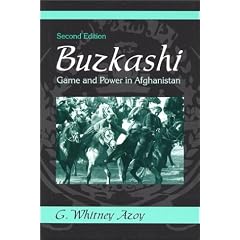
G Whitney Azoy, a US foreign service information officer in the 1970s, studied the game and eventually his PhD was published ‘Buzkashi: Game and Power in Afghanistan’ (Univ of Pensylvania, 1982). His is one of the best descriptions:
‘Horsemen struggle over a mutilated calf carcass. Great clouds of dust rise from the ground as powerful horses lurch and rear, kick and bite, in a frenzy of charges and counter charges. Whips clenched in their teeth, the riders lean down and grab at the calf, wrench it clear and determine who can control what may be the wildest game in the world’


Originally introduced by the Mongol hordes of Central Asia, it evokes images of Genghis Khan, who swept throughout the region, decimating the population. The historian Louis Dupree, writes that these nomads ‘used prisoners of war instead of goats, dismembering the hapless creatures and reducing them to a mass of hominid jelly during the play’ Nowadays it is the carcass of a goat or calf, soaked in water for a few days to toughen it .

His wife, Nancy Hatch Dupree in her classic Tourist guide to Afghanistan (1970) writes more poetically
‘The tremendous skill and electrifying excitement engendered by daring riders atop glistening horses, sometimes galloping flat out, sometimes rearing with flailing hoofs above an opponent, make the game irresistibly compelling’
Irresistibly compelling it certainly is. I first saw a game being playing in Khorasan refugee camp in Peshawar in 1995. It was wild, exciting, chaotic, exhilarating, uninhibited, engaging, incomprehensible, uncontrollable, mystifying. A world apart from the rules of the familiar ‘west’. It belonged to another time and place.

Play, Parable and Paradox

Buzkashi is foremost a game played enthusiastically by the wild horsemen of Central Asia. But it is also a sort of a parable. According to Afghans ‘If you want to know what we’re really like, go ands watch a Buzkashi match’.

Roland and Sabrina Michaud have managed to capture magnificent images of Afghanistan. Perhaps none more so than their ‘Horsemen of Afghanistan’ ( Thames & Hudson 1988)
‘But is game the right word?’ they ask ‘It is a ritual, a celebration, a test of courage, strength and skill on the part of both man and horse. It is the culmination of years of training, a symbolic struggle that has all the power of drama and all the heart-stopping excitement of athletic prowess . It is a sport of individuals not teams’
It symbolises much of what it means to be Afghan, with the elite riders, or chopendoz, enjoying the status of national heroes .

It has therefore become a favourite metaphor both for the Afghan character and for the present power struggle inside Afghanistan. Afghanistan is the Buz, the goat, that has been torn apart by teams from Britain and Russia in the Great Game in the 19th century. By Russia, America, Pakistan and Saudi Arabia during the latter part of the 20th century. And now, yet again, by America and Britain in the ‘War on Terrorism’, the so called ‘first war of the 21st century’.

Sir Alexander Burnes (Cabool, 1834) around the time of the first Afghan War, observed
‘The rapidity with which the goat sometimes changes masters is very laughable; but the poor animal is occasionally torn to pieces in the scuffle’
As in Buzkashi, individual actors struggle for control and gain it only for as long as they can hang on. So with modern Afghanistan, individual commanders and regimes have held on for periods of time. The problem is it has been destroying the country. The current allied bombing is completing the job.


Power struggle
Although the game may appear like an anarchic melee, George Arney, the journalist, writing at the time of the Russian withdrawal, suggests
‘Buzkashi does have rules, not least of which is that there are 2 teams of roughly equal size, whose players are all invited to participate. After 10 years in which Afghanistan itself has become the headless goat, torn and ripped apart by contending foreign powers, it is time for the Afghans to be left to play out their own power-struggle and their own national destiny according to their own rules’
‘Afghanistan: the definitive account of a country at a crossroads’ (Mandarin 1989)

Indeed they were left to play, more deserted, by the west after the end of the cold war. This has been a bone of contention and a source of some of the Taleban’s current enmity with the West. Another 10 years on, after the Russian withdrawal, Afghanistan is again at a crossroads. The power struggle continues. Afghanistan must be left alone. Afghanistan needs help. That is the paradox. Assistance not interference.

Whatever form a government takes, post America’s ‘War on Afghanistan’, the Afghans themselves need to ‘play the game by their own rules’. Buzkashi not Baseball.