
Journey into Cyprus
Cyprus republic and third largest Island in the Mediterranean Sea. (225 km long and 97 km wide: an area of 9251 sq.km). Greek speaking
Cyprus republic and third largest Island in the Mediterranean Sea. (225 km long and 97 km wide: an area of 9251 sq.km). Greek speaking
Cyprus makes up about 80% of the population. About 18% is of Turkish extraction, and the remainder is made up of Armenian and other ethnic groups.
Both the Greeks and the Turkish communities retain the customs and to a great extent the national identities of their co-religionists on the mainland. Since the Turkish invasion of 1974, mass migrations of Greeks and Turks have taken place, so that now the two groups are geographically separated. The Greeks occupy the southern two-thirds of the island and the Turkish Cypriots occupy the Northern third.
The people are predominantly farmers who work the land surrounding their villages. Members of the Greek community adhere to the Church of Cyprus, which is in doctrinal agreement with the Eastern Orthodox church, but is independent and has no allegiance to any patriarch. The Archbishop Primate, who is Bishop of Nicosia and the three other Bishops of the Cypriot church are elected by the church membership. The Turkish minority is mostly Muslim. Other small religious groups include Maronites (Christian Arabs), Roman Catholics and Jews.
Cyprus’ Microsoft Encarta
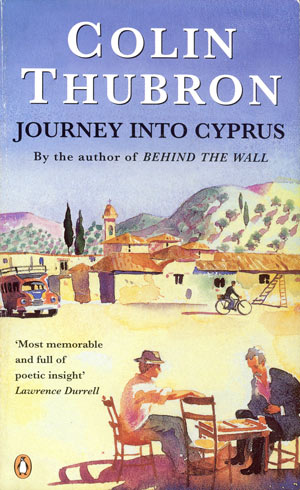
I was travelling to Aphrodite’s Island for the third, maybe even the fourth time. At the time, I was reading Colin Thurbron’s ‘Journey into Cyprus’, detailing his 600 miles trek on foot around Cyprus in the last year of the island’s peace. It’s a book rich in succinct insights. He explains how, since his journey, the two parts of the island have been stamped with their own personalities:‘The north has fallen into neglect, the south into over-exploitation.’
He also offers a helpful explanation for the religious mixtures that abound:
This is folk religion at its most basic - so apparent and endemic in the region. I visited an orthodox church in Lefkara, a village famous for its lace: ‘Lefkaritika’. I wasn’t so much interested in the lace, more the legends.
Both the Greeks and the Turkish communities retain the customs and to a great extent the national identities of their co-religionists on the mainland. Since the Turkish invasion of 1974, mass migrations of Greeks and Turks have taken place, so that now the two groups are geographically separated. The Greeks occupy the southern two-thirds of the island and the Turkish Cypriots occupy the Northern third.
The people are predominantly farmers who work the land surrounding their villages. Members of the Greek community adhere to the Church of Cyprus, which is in doctrinal agreement with the Eastern Orthodox church, but is independent and has no allegiance to any patriarch. The Archbishop Primate, who is Bishop of Nicosia and the three other Bishops of the Cypriot church are elected by the church membership. The Turkish minority is mostly Muslim. Other small religious groups include Maronites (Christian Arabs), Roman Catholics and Jews.
Cyprus’ Microsoft Encarta
I was travelling to Aphrodite’s Island for the third, maybe even the fourth time. At the time, I was reading Colin Thurbron’s ‘Journey into Cyprus’, detailing his 600 miles trek on foot around Cyprus in the last year of the island’s peace. It’s a book rich in succinct insights. He explains how, since his journey, the two parts of the island have been stamped with their own personalities:‘The north has fallen into neglect, the south into over-exploitation.’
He also offers a helpful explanation for the religious mixtures that abound:
‘Dig up a saint and you uncover a god!’In Cyprus, religion seems to be as layered as its history.
‘All over the Levant, the ruins of Aphrodite’s temples are betrayed by trees hung with the clothing of diseased petitioners, by candles and figurines which are offered to ‘the Lady’. In uninterrupted worship, Aphrodite has become the Virgin Mary. The temple itself falls, the deity remains’.
This is folk religion at its most basic - so apparent and endemic in the region. I visited an orthodox church in Lefkara, a village famous for its lace: ‘Lefkaritika’. I wasn’t so much interested in the lace, more the legends.

This was an ordinary village church, with its grotto of saints and icons. Among the candles and coins were wax limbs – arms, heads, legs - representative body parts. ‘For the icons effect cures’, explains Thubron.

It seemed to me that in this Region where churches and mosques, priests and mullahs almost look identical, there is much room for authentic religion, which answers people deep needs for health, hope and healing.
From your own correspondent
‘Conceived in a time when medicine could do little, they had to cope single-handed with the fears and sicknesses of the Christian world. Cyprus alone is filled with these immemorial doctors whose bedside manner is one of numinous and infallible strength. They nestle propitiously behind spinneys of candles and drip with ex-votos: silver arms, legs, ears, eyes, hordes of coins and necklaces, wax statuettes. They cater for even trivial ailments. St. Yennadios of Mononero, who was frozen to death by the Cypriot winter, can cure the common cold; St Antipas soothes tooth-ache; St. Procopius will banish boils; and the lion-riding St. Mamas at Troulli, as well as dealing with tax matters, will relieve sore throats’
It seemed to me that in this Region where churches and mosques, priests and mullahs almost look identical, there is much room for authentic religion, which answers people deep needs for health, hope and healing.
From your own correspondent
October 1999


No comments:
Post a Comment