
The Return of the Prodigal
Harmensz van Rijn Rembrant (1606- 1669)
Harmensz van Rijn Rembrant (1606- 1669)
‘He painted father and son, God and humanity, Compassion and misery in one circle of love’ (pg7)

‘The younger brother allows himself to be held in a forgiving embrace (found) The elder brother stands back, looks at his fathers merciful gesture and yet cannot step over his anger (lost)’
‘Here is the God I want to believe in : a Father who, from the beginning of creation, has stretched out his arms in merciful blessing, never forcing himself on anyone, but always waiting, never letting his arms drops down in despair, but always hoping thatb his children will return so that he can speak words of love to them and let hs tired arms rest on their shoulders. His only desire is to bless’ (p 95/6)
Ever since I read the book, I have wanted to take the opportunity of visiting St Petersberg, and to do a ‘Henri Neuwen’. He had spent hours contemplating Rembrant’s painting and he wrote his spiritual treatise – The Return of the Prodigal Son - as a result.
There was long queue outside the Hermitage, but as always a fast track entrance was available. Once inside, I made a beeline for the Rembrant collection.

‘My heart leapt when I saw it …After my long self -exploring journey, the tender embrace of father and son expressed everything I desired at that moment. I was indeed the son exhausted from long travels. I wanted to be embraced. I was longing for a home where I could feel safe. The son-come-home was all I was and wanted to be. For so long I had been going from place to place: confronting, beseeching, admonishing and consoling. Now I desired only to rest safely in a place where I could feel safe at home.’ (pg 5)
The Hermitage acquired the painting in 1766, from the Duke of Amezune’s collection Paris. It is based on the story of the ‘prodigal son’ in Luke 15: 20-24. The light focuses on the kneeling son and stooped father in gentle embrace, who embody repentance and forgiveness. Three other dark characters look on indifferently from the shadows. The older sons stands aloof -
‘I never had run away from home…. Never wasted my time and money in sensual pursuits and never gotten lost in ‘debauchery and drunkenness’. For my entire life, I had been quite responsible, traditional and homebound. But with all that, I may in fact have been just as lost as the younger son. I suddenly saw myself in a completely new way. I saw my jealousy, my anger, my touchiness, doggedness and sullenness and most of all my subtle self-righteousness. I saw how much of a complainer I was and how much of my thinking and feeling was ridden with resentment. For a time it became impossible to see how I could ever have thought of myself as the younger son. I was the elder son for sure, but just as lost as his younger brother, even though I had stayed ‘home’ all my life’. (pg 20)
 The father has prominent hands: Neuwen suggests a strong male left and softer female right, resting on the sons back, capturing the androgyny of God. The bare head and calloused foot of the son, clothes, torn and filthy, suggest hardship and exposure. The rich red cloth on the fathers shoulders, paralleled by the elder son on the right, suggest opulence. This is reinforced by the size of the painting, maybe 10’ x 6’, in its rich gold frame. Groups stop, English, Japanese, Russian, Italian, German and spend a few minutes, with commentary from their respective guide - and then they move on. There are lots of other paintings to see. Individuals sit and read the explanation and contemplate.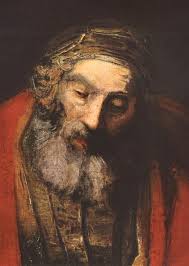
It is indeed a wonderful painting, rich in biblical meaning. Neuwen expresses its message and mission so well:
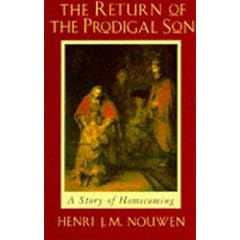
‘Whether you are the younger son or the elder son, you have to realise that you are called to become the father. The time has come to claim your true vocation - to be a father who can welcome his children home without asking them any questions and without wanting anything from them in return. Not a good friend or a kind brother… a father who can claim for himself the authority of true compassion.’ (pg 22)
From your own correspondent
The Hermitage,
St Petersberg, April 2001
The Hermitage,
St Petersberg, April 2001


No comments:
Post a Comment